
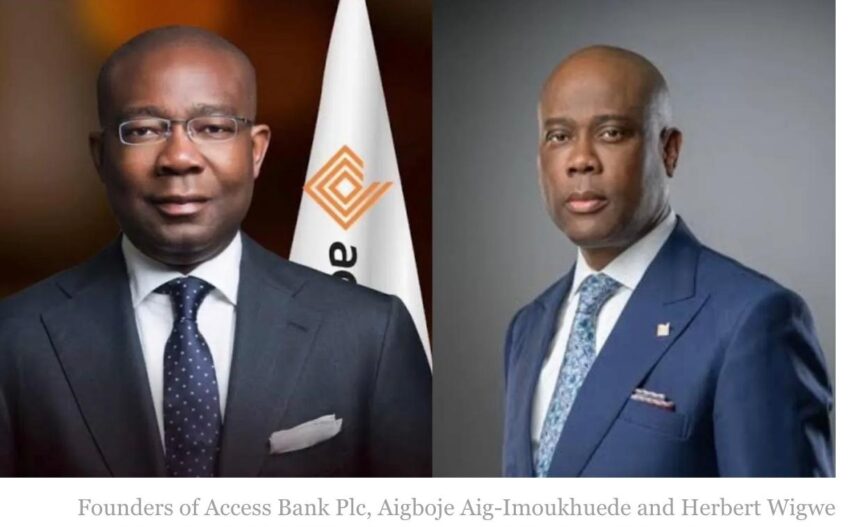
● Investigation links Access Bank CEO with late partner’s financial footprint across 20 countries
● How UK property disclosures, Cyprus filings and Isle of Man records uncovered global entities previously shielded from public view
● The complex alliance at the centre of global network spanning banking, energy, fintech and real estate
The desert kept the silence for a long time. Across the scorched emptiness of California’s Mojave wilderness, twisted metal lay under the indifferent sky after the helicopter carrying Herbert Wigwe crashed in February 2024.
Death arrived with terrifying swiftness. Within moments, one of Africa’s most formidable banking minds vanished alongside his wife, Doreen, his son Chizi, and three others.
As Nigeria mourned Wigwe, Financial markets staggered beneath the shock. Boardrooms across Lagos, London and Johannesburg fell into uneasy silence.
Yet grief barely had time to settle before another story began to unfold about offshore filings, corporate registrations, property records and the scandalous paper trails of global finance.
Behind the public image of the charismatic banker who transformed Access Bank from a restless mid-tier institution into a continental powerhouse stood a colossal commercial architecture stretching across at least 20 countries and more than 80 companies.
The network spread through Nigeria, Mauritius, Cyprus, Jersey, the Isle of Man, the United Kingdom and the United States, weaving through secrecy jurisdictions, tax havens, investment vehicles, property structures, energy firms, fintech ventures and family offices.
At the heart of that sprawling universe stood two men whose names became inseparable within modern Nigerian banking history: Herbert Wigwe and Aigboje Aig-Imoukhuede.
One became the public face of expansionist ambition. The other evolved into the calculating strategist whose fingerprints appeared repeatedly across the corporate lattice now attracting fierce scrutiny amid a bitter family dispute over Wigwe’s estate.
Together, they built an empire that strode across continents and engineered one of the most aggressive banking transformations ever witnessed in Africa.
Together, they are also mired in scandal as corporate records, offshore filings, property documents and company registrations scattered across several jurisdictions now reveal the scale of a commercial empire that extended far beyond the visible boundaries of Access Holdings. The records point to more than 80 companies linked to Wigwe across at least 20 countries, exposing an intricate network of offshore entities, investment vehicles, real estate holdings, trusteeships, energy firms, fintech interests and family wealth structures.
The documents also illuminate the enduring business alliance between Wigwe and Aigboje Aig-Imoukhuede, the former Access Bank chief executive whose partnership with Wigwe helped reshape modern Nigerian banking. Their relationship appears repeatedly across corporate filings, joint ventures and wealth management structures spread across Nigeria, Mauritius and other financial jurisdictions.
Those records have surfaced amid a growing dispute surrounding Wigwe’s estate, drawing Aig-Imoukhuede into a controversy that has unsettled sections of Nigeria’s corporate elite.
At the centre of the global network stands Tengen Family Office, an Ikoyi-based wealth management firm jointly owned by Wigwe and Aig-Imoukhuede. Incorporated in 2017, the entity represented a private financial command centre for both men, each holding equal stakes. Another Nigerian entity, Tengen FOL Limited, mirrored the same ownership structure.
Their business alliance extended into Mauritius, a jurisdiction long favoured by multinational investors and high-net-worth individuals seeking tax efficiency and discreet financial structuring. Under the Coronation Capital umbrella, the two bankers established Tengen Holdings Mauritius in 2019.
That Mauritian entity later emerged prominently within Wigwe’s shareholding structure in Access Holdings.
According to Access Holdings’ audited 2023 financial report, Wigwe held 2.59 billion shares valued at approximately N65.3 billion, representing 7.3 per cent of the group’s issued shares at the time. A substantial portion of those shares sat within Coronation Trustees Tengen Mauritius, an offshore structure linked to his indirect holdings.
The records show that Wigwe’s holdings in Access Corporation included direct and indirect stakes routed through United Alliance Company of Nigeria Limited, Trust and Capital Limited and Coronation Trustees Tengen Mauritius.
The offshore footprint extended well beyond banking investments.
Company filings in the United Kingdom and Europe reveal an elaborate network of holding firms and property-linked entities connected to the late banker. British records identify Lodging Holding Ltd as one of the overseas entities associated with Wigwe. Carmel Gate Ltd also appears within the portfolio, alongside Access Bank UK.
Cyprus provided another corridor into the architecture of his wealth. Deansleigh Holdings Limited first emerged there in 2015 before later transitioning into a UK holding company. Wigwe reportedly held a 25 per cent stake in the business. Other Cypriot entities tied to his network include Belde Co Ltd, Vendereso Corporation Limited, Lodging Holding Limited and QEXLE Trading Limited.
Jersey, one of the world’s most discreet offshore jurisdictions, also appears within the paper trail. Records there connect Wigwe to One Southbank Properties Limited and Glenq Private Wealth Limited.
Several of those entities remained largely invisible to public scrutiny for years because of the secrecy protections associated with offshore financial centres. Wealth advisers frequently establish such structures for estate planning, liability management, tax efficiency and cross-border investments. Ownership records within some jurisdictions remain shielded from public access, allowing luxury assets and corporate interests to sit quietly behind shell companies.
British transparency reforms eventually peeled back portions of that secrecy.
Property records linked more than 100 London properties to entities associated with Wigwe. Those details surfaced after the United Kingdom introduced new beneficial ownership disclosure requirements through the Economic Crime (Transparency and Enforcement) Act 2022. Before the legislation took effect, overseas entities could acquire British properties while concealing the individuals behind them.
The Isle of Man provides some of the oldest traces of Wigwe’s offshore activity.
Records there show that Warne Limited was registered in 2006 by Wigwe alongside Zedra Trust Company Limited. DHT Limited followed in 2008. Balladoyne Limited emerged in 2010 under similar arrangements. Weeks before Wigwe’s death, his shares in Balladoyne were reportedly transferred to unidentified legal entities.
American filings reveal another layer of the network.
Beraug Investments LLC was incorporated in Florida in 2007 with Wigwe, his wife Doreen and their children listed among the owners. Beraug Consulting Services Corporation later appeared in Miami. Grosvenor Marine LLC also surfaced in Florida records, with Herbert and Doreen Wigwe listed as directors.
Washington, D.C., hosted another entity, Obele Incorporated, which lists members of the Wigwe family among its beneficial owners.
Nigeria itself contained the broadest concentration of Wigwe’s business interests.
Records show his involvement in construction, fintech, oil and gas, financial infrastructure, hospitality, real estate and philanthropy. Beraug Realty Ltd traces his entrepreneurial footprint back to 1993, while Beron Shyngle Ltd linked him with his father, Shyngle Wigwe.
Several ventures tied Wigwe directly to Aig-Imoukhuede.
Fusion Construction Limited listed both men among its directors. United Alliance Company of Nigeria and Trust and Capital Limited operated as equal partnerships between them. AAHW Limited reflected another 50-50 ownership arrangement.
Oil and gas investments further deepened the alliance. Petralon 10 Limited and Petralon 30 Limited positioned both men within upstream, midstream and downstream petroleum operations. Petralon Trading and Supply Limited also connected them with other prominent Nigerian business interests, including businessman Babatunde Folawiyo.
The late banker also expanded aggressively into digital finance. Hydrogen Payment Services Limited linked him with Ogbonna Roosevelt Michael, while Unified Payment Services Ltd brought together several senior banking figures on its board, including Kennedy Uzoka and Adebola Adeduntan.
Wigwe’s influence spread through several major civic and philanthropic institutions. He appeared within the records of Africa Initiative for Governance, The HOW Foundation, CACOVID-19 Ltd/GTE and The AIG Foundation. He also occupied positions within financial market infrastructure organisations, including NG Clearing Ltd alongside the Nigerian Sovereign Investment Authority, the Nigerian Stock Exchange and several leading banks.
The reach of Access Holdings itself amplified his influence across the continent.
Under Wigwe’s leadership, Access Holdings expanded operations into Ghana, Sierra Leone, Zambia, Mozambique, South Africa, Botswana, Cameroon, Angola, Kenya, Rwanda, Gambia and Guinea, alongside its United Kingdom operations. The expansion transformed the institution into one of Africa’s largest banking groups before Nigeria’s currency devaluation altered continental rankings.
By September 2025, Access Holdings’ assets reportedly stood at N52.2 trillion.
Wigwe’s death interrupted a career still operating at full momentum. Plans for Wigwe University had only recently begun to crystallise. International expansion remained active. New investments continued to emerge across several sectors.
The tragedy soon gave way to another battle.
Court filings connected to Wigwe’s estate revealed a growing family dispute over the distribution of his assets. His father, Shyngle Wigwe, reportedly filed a caveat challenging aspects of the proposed estate arrangements.
The dispute widened after Christian Wigwe, identified in court documents as Herbert Wigwe’s cousin, accused Aig-Imoukhuede of assuming indirect guardianship over Wigwe’s children and assets. The allegations intensified scrutiny around the corporate and personal relationship between both men.
The controversy added emotional turbulence to an already sensitive moment within Nigeria’s financial establishment.
Questions surrounding inheritance structures, offshore entities and asset control began circulating through legal and corporate circles. The scale of Wigwe’s holdings ensured that any disagreement over succession would carry enormous financial implications.
Those revelations have also renewed broader conversations about secrecy jurisdictions and beneficial ownership transparency.
Global financial centres such as Jersey, Mauritius and the Isle of Man continue to attract wealthy individuals seeking privacy and tax advantages. Critics argue that such systems allow politically connected elites and influential corporate figures to shield assets behind opaque structures. Advocates of offshore finance counter that the arrangements often serve legitimate commercial purposes tied to international investment and estate planning.
Wigwe’s corporate network now stands as one of the most striking examples of how vast private wealth can exist beyond the full visibility of public scrutiny, even when associated with one of Africa’s most recognisable banking executives.
The records portray a businessman who understood modern capital as a borderless instrument. His companies stretched from Lagos to London, from Nicosia to Miami, from Port Louis to the Isle of Man. The network carried the names of family members, longtime associates and trusted business allies.
Aig-Imoukhuede’s recurring presence within many of those structures underscores the depth of a partnership that shaped Access Bank’s rise from a local institution into a continental force.
Together, both men became defining figures within Nigerian banking history. Their alliance fused aggressive expansion with sophisticated financial engineering, producing a business empire whose full dimensions only became visible after tragedy shattered its centre.
The paper trail left behind now reads like a hidden map of elite African capital in the age of global finance.