
● Billionaire Magnates Redefine Brotherhood amid Posh Theatre of Global Capital, Ramadan
● How they found Serenity Beneath UAE’s Golden Skies
Even empires require silence. Even titans of industry seek a horizon where the noise of markets dissolves into the hush of contemplation. Beneath the sunlit majesty of Dubai’s sculpted skyline, glass towers shimmer against the desert and the sea cools marble promenades, hosting two of Nigeria’s most accomplished businessmen.
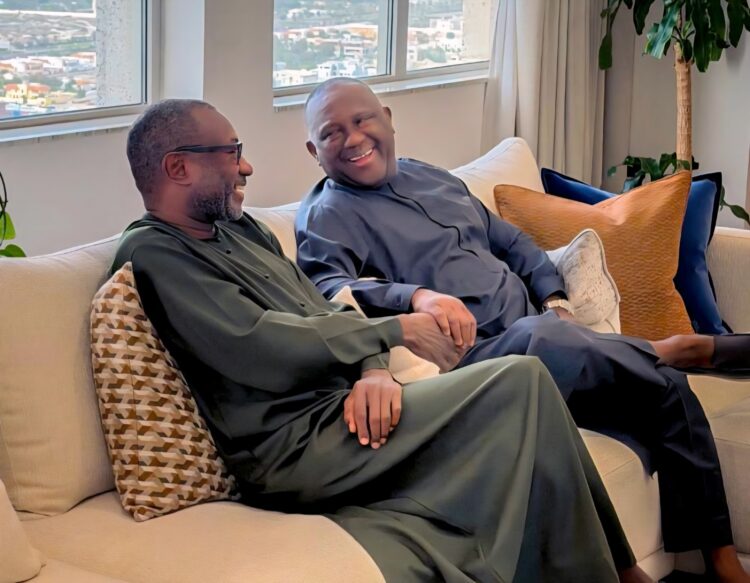
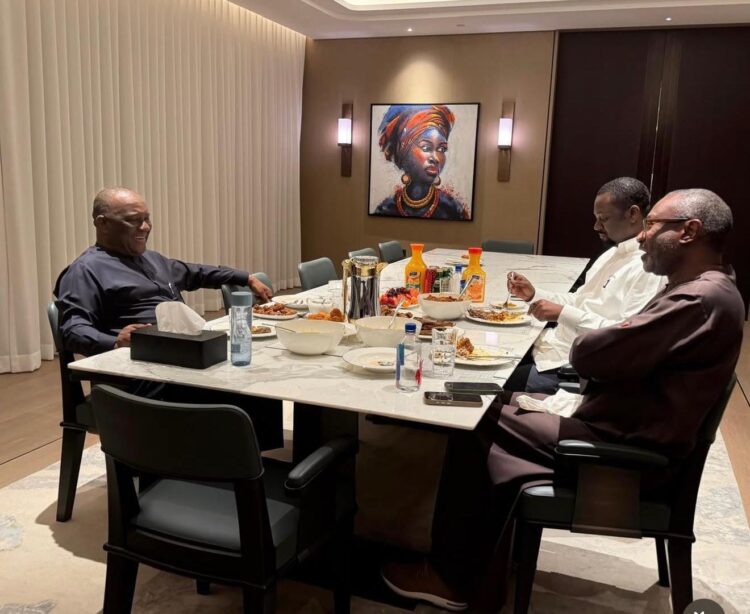
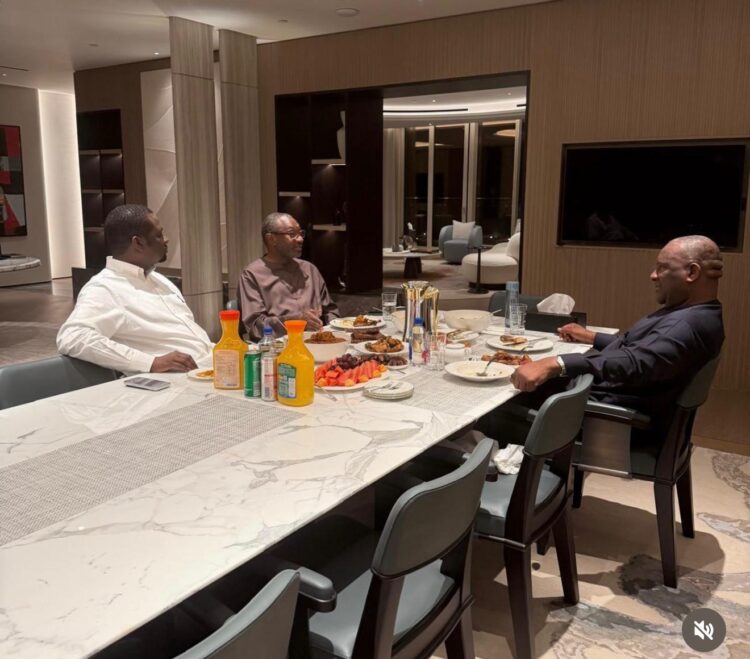
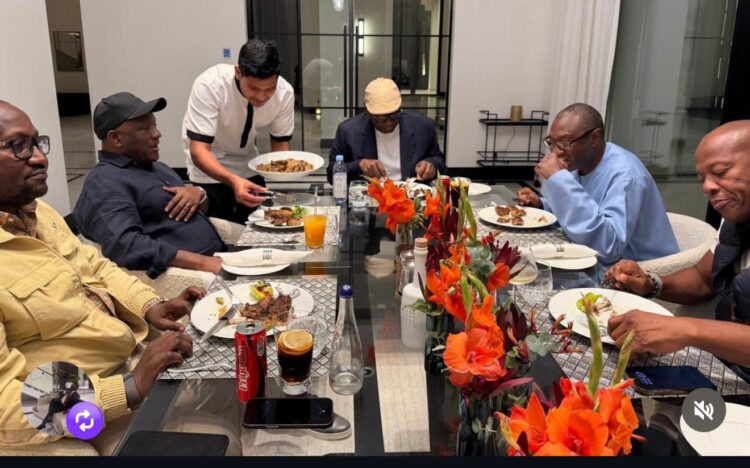
Recent images shared across digital platforms revealed an intimate prospect: Abdul Samad Rabiu and Femi Otedola seated in warm companionship in Dubai, breaking fast together during Ramadan. The photographs, simple yet resonant, captured more than a dinner. They evoked brotherhood, spiritual pause and the soft diplomacy of friendship forged at the summit of global enterprise.
Rabiu briefly captioned one such moment with understated affection: “Ramadan Day 3 — Iftar at home in Dubai with my great brother Femo @realFemiOtedola! Truly honoured�� Joined by Kabiru…” In that restrained sentence lived a world of reverence, gratitude and fraternal warmth.
The evening glowed with a tender symbolism. Lantern light, the crescent rhythm of Ramadan, and the soothing symbolism of shared Iftar converged in Rabiu’s private residence. Soft desert winds, the golden hush of twilight, and the sacred cadence of fasting broken in fellowship shaped the mood of that evening.
There was no spectacle or ostentation. Only brotherhood and presence; and the serene choreography of two Nigerian industrial titans who, while fiercely patriotic and deeply invested in the destiny of their homeland, have found in Dubai a second home of repose and cultured exclusivity.
Beyond the lyrical charm of the images that mesmerised admirers across the virtual space, the gathering reflected a pattern that has gradually become evident: Dubai has evolved into a tranquil axis for high-level African business engagement. For leading figures whose schedules are defined by boardroom urgency, regulatory recalibration and cross-continental investment strategies, the city offers a rare equilibrium between discretion and grandeur.
For Otedola, whose public life swings between corporate stewardship and strategic financial order, Dubai provides a serene ambience where relationships are nurtured away from the frenetic pressures of Lagos’ financial corridors. As Chairman of First HoldCo Plc, the parent company of First Bank of Nigeria Limited, his involvement in recapitalisation efforts to meet the Central Bank of Nigeria’s N500 billion capital threshold has placed him at the epicentre of Nigeria’s evolving banking architecture.
That corporate momentum has coincided with major portfolio restructuring. In December 2025, Otedola executed a landmark divestment, selling 77 percent of his stake in Geregu Power Plc to MA’AM Energy Limited in a $750 million transaction. The deal transferred the indirect controlling interest previously held through Amperion Power Distribution Company Limited, marking a decisive transition in the ownership structure of one of Nigeria’s most significant power-generation assets.
Geregu Power, listed on the Nigerian Exchange and widely regarded as a strategic pillar within the country’s electricity sector, maintains an installed capacity of 435 megawatts. Otedola’s stewardship since acquiring the plant in 2013 and leading its historic public listing in 2022 established it as the first power-generating company to be listed on Nigeria’s exchange. Subsequent share reductions and the recent transaction reflect a calibrated repositioning aligned with long-term strategic interests.
Financial indicators from the company have remained robust. Pre-tax profit for the three months to September rose by 82 percent to N11.2 billion, supported by a 37 percent increase in quarterly revenue to N43.8 billion. Nine-month revenue climbed to N131.5 billion, while pre-tax profit reached N37.5 billion, signalling sustained operational strength amid Nigeria’s complex energy landscape.
Across the polished dining table in Dubai sat Rabiu, whose own industrial empire has expanded with methodical intensity across manufacturing, food production, infrastructure and energy. As Chairman of BUA Group, he continues to spearhead investments designed to deepen Nigeria’s industrial self-sufficiency while reducing structural dependence on imports.
Among his recent strategic initiatives is an agreement with Green Power International Pvt. Ltd. to develop a 22-megawatt gas-fired power plant, a project intended to enhance energy reliability for BUA’s operations and significantly reduce diesel consumption across its production facilities. The initiative aligns with broader efficiency goals and cost optimisation within the conglomerate’s manufacturing ecosystem.
BUA’s expansion trajectory has also encompassed significant agribusiness and industrial undertakings. Agreements signed between late November and early December include a 32-tonnes-per-hour rice processing line and a partnership with Türkiye’s Viteral Integrated Milling Systems to establish a 40-tonnes-per-hour animal feed mill in Kano. Running parallel to these projects is an integrated sugar complex projected to process 10,000 tons of cane daily, generate 35 megawatts of electricity from bagasse and produce 20 million litres of industrial ethanol annually.
Such investments underscore Rabiu’s enduring commitment to Nigeria’s industrial renaissance. Financial performance across his publicly listed entities reinforces this trajectory. BUA Foods Plc reported profit of N405.2 billion for the nine months ended September 30, 2025, more than doubling the N201.4 billion recorded in the corresponding period of the previous year. Revenue rose to N1.42 trillion from N1.07 trillion, reflecting higher sales volumes and disciplined cost management during a period characterised by inflationary pressure and supply-chain disruptions.
BUA Cement recorded similar gains, with profit increasing to N289.86 billion from N48.97 billion, while revenue expanded to N858.7 billion from N583.4 billion. Growth in equity and total assets further strengthened the company’s balance sheet, consolidating its role as a key driver of Nigeria’s infrastructure ecosystem.
Against this backdrop of corporate expansion and strategic repositioning, the Dubai gathering assumes deeper analytical significance. It represents a convergence point where business diplomacy intersects with personal fraternity. Away from regulatory briefings, shareholder expectations and public scrutiny, such moments offer an environment conducive to reflective dialogue and long-range strategic contemplation.
Dubai’s appeal to global billionaires lies partly in its unique synthesis of luxury, privacy and geopolitical neutrality. The city has steadily evolved into a preferred meeting ground for international capital, where informal conversations frequently precede formal transactions. Its infrastructural precision, secure environment and cosmopolitan ambience create a conducive setting for high-level engagement without the operational constraints often associated with traditional financial hubs.
For Nigerian magnates navigating volatile macroeconomic conditions at home, this environment offers psychological respite without diluting patriotic commitment. Both Otedola and Rabiu remain deeply invested in Nigeria’s economic development, channeling vast resources into domestic industries that generate employment, reduce import dependency and strengthen national capacity.
Observers within business and diplomatic circles interpret the visual narrative of their Ramadan Iftar as emblematic of a broader cultural phenomenon: African billionaires embracing global mobility while retaining an unwavering emotional and financial allegiance to their home countries. The symbolism resonates particularly during Ramadan, a period defined by reflection, charity and spiritual recalibration.
The photographs shared online on February 20, 2026, captivated audiences across social media platforms, drawing admiration for their warmth and authenticity. Admirers described the images as endearing, elegant and profoundly humanising, portraying two business titans in a moment of quiet simplicity rather than corporate grandeur.
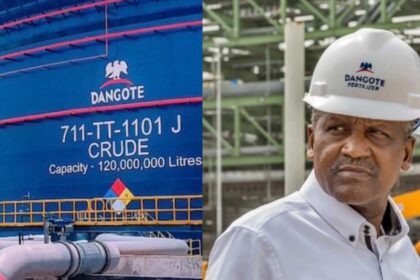
That simplicity, however, is layered with significance. The gathering followed a period of heightened industrial activity across Nigeria’s economic landscape, including Otedola’s widely publicised visit to the Dangote Petroleum Refinery in Lekki, which he described as the “eighth wonder of the world” after touring the facility and witnessing its operational capacity.
The refinery, designed to reach full production capacity of 650,000 barrels per day, represents a monumental stride toward reducing Nigeria’s reliance on imported petroleum products. Expansion plans targeting 1.4 million barrels per day further align with the vision of industrial self-sufficiency championed by leading Nigerian entrepreneurs, including Rabiu through his extensive investments in manufacturing and agribusiness.
Dubai, therefore, emerges within this narrative as a serene extension of their global operational footprint. Meetings held within its tranquil residences and elegant lounges are often synchronised with broader conversations about investments, regulatory frameworks and cross-border collaborations affecting Africa’s economic trajectory.
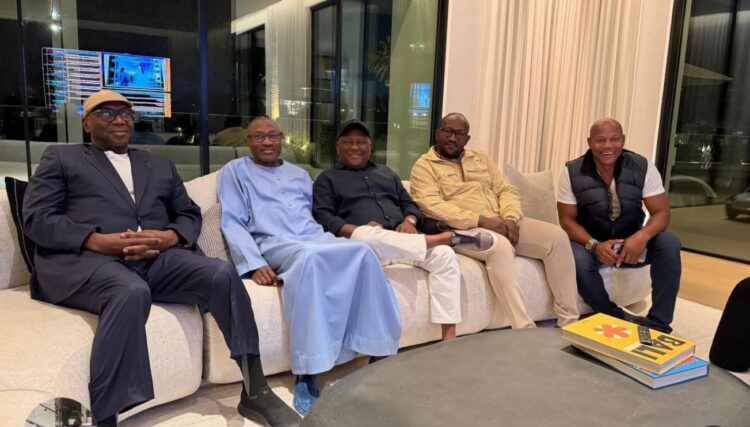
Sources familiar with the gathering describe it as private, cordial and deeply reflective of longstanding mutual respect between the two businessmen. Kabiru, Rabiu’s younger brother, also joined the evening, reinforcing the familial tone of the Iftar and amplifying its emotional resonance.
Beyond the aesthetics of the images lies a deeper strategic rhythm. Both men oversee enterprises undergoing significant transformation across banking, power, manufacturing and agribusiness sectors. Their interactions, whether in Lagos, Abu Dhabi or Dubai, frequently align with moments of strategic recalibration within their respective conglomerates.
Dubai’s emergence as a second home for the duo does not signal detachment from Nigeria. On the contrary, their investment portfolios and philanthropic initiatives remain overwhelmingly anchored within the Nigerian economy. Rabiu’s interventions in education, healthcare and food security, alongside Otedola’s contributions to energy, banking and infrastructure, continue to reinforce their reputations as unapologetically pro-Nigerian industrialists.
Yet, the allure of Dubai’s exotic bliss, serene exclusivity and architectural elegance offers a complementary dimension to their demanding lifestyles. Marble courtyards, panoramic skylines and ocean-facing residences create an atmosphere conducive to reflection, spiritual observance and high-level engagement conducted away from the relentless tempo of domestic economic theatres.
Industry analysts note that such international retreats often facilitate candid exchanges that would be difficult within more formal corporate environments. The absence of media glare, coupled with the city’s culture of discretion, encourages strategic conversations grounded in long-term vision rather than short-term market reaction.
Their recent hosting of each other in Dubai further reinforces the depth of their personal rapport. Earlier accounts indicated that Otedola had previously welcomed Rabiu and select dignitaries to his own residence in the city, describing the evening as memorable and enriched by warm hospitality and distinguished company. The reciprocity of these gatherings illustrates a relationship defined by mutual respect rather than transactional convenience.
Public reaction to the photographs has remained overwhelmingly celebratory. Many admirers interpreted the scenes as an inspiring display of brotherhood among Nigeria’s wealthiest entrepreneurs, emphasising the importance of unity within the country’s business elite during a period of economic transition.
Within diplomatic and corporate circles, the symbolism extends even further. Their presence in the United Arab Emirates coincided with heightened international investment dialogue, including sustainability engagements and energy discussions involving Nigerian stakeholders. Such timing reinforces the perception of Dubai as a strategic crossroads for global economic interaction.
For Rabiu, whose industrial philosophy consistently emphasises domestic value creation, the quiet elegance of hosting Iftar in Dubai reflects a harmonious blend of global sophistication and cultural rootedness. Ramadan gatherings, especially among Muslim business leaders, often transcend social formality to become moments of spiritual communion and strategic reflection.
Likewise, Otedola’s participation underscores his reputation as a businessman who balances corporate decisiveness with refined personal relationships. His recent social media activity, including the posting of the Dubai photographs on February 20, 2026, added a digital dimension to the narrative, allowing the public to glimpse a softer, more contemplative side of his otherwise intensely strategic persona.
The mesmerising quality of the images lay in their understated authenticity. No elaborate staging. No theatrical opulence. Only genuine camaraderie framed within the gentle luxury of Dubai’s ambient elegance.
Economic observers increasingly highlight how global Nigerian entrepreneurs navigate dual geographies: one defined by operational investment in Nigeria, the other by strategic reflection in international hubs. Dubai’s rise within this equation mirrors its broader transformation into a nexus for global wealth management, diplomatic dialogue and discreet high-level networking.
Amid expanding empires and complex transactions, the quiet ritual of breaking fast together carries profound symbolic weight. It signals humility within power, fraternity within influence and spiritual grounding within material success.
Ultimately, the narrative of Otedola and Rabiu in Dubai is less about relocation and more about resonance. A resonance of brotherhood. A resonance of shared vision. A resonance of global stature anchored firmly in Nigerian identity.
Their laughter over Iftar, their reflective pauses, and their mutual expressions of honour capture a portrait of modern African capitalism shaped by loyalty, ambition and cultural continuity. Beneath Dubai’s luminous skyline, two Nigerian titans continue to demonstrate that global mobility and national devotion can coexist with grace.
In that serene desert city where silence carries its own authority, they have found a second home of peace, exclusivity and reflective splendour. Yet their economic heartbeat, philanthropic impulse and industrial imagination remain unmistakably Nigerian, pulsing with unwavering commitment to the prosperity of their homeland while they, occasionally, retreat to Dubai’s tranquil embrace to renew strength, deepen bonds and contemplate the next chapters of their extraordinary journeys.