
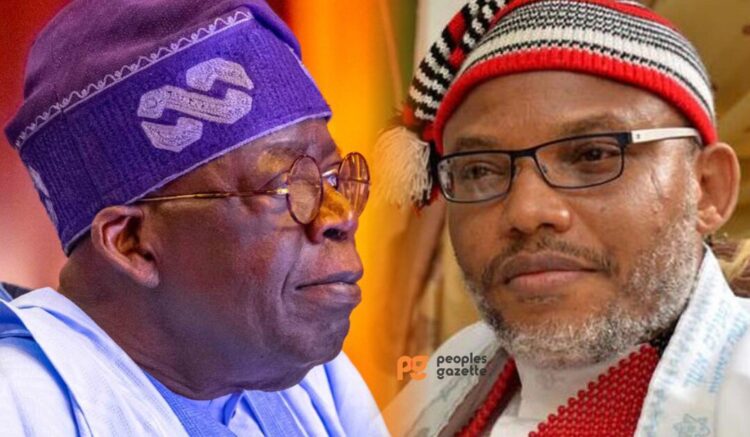
A viral Facebook video circulated claims that the United Nations issued a 60-day ultimatum to the Nigerian government over the detention of Nnamdi Kanu.
Social media users expressed mixed reactions, with some welcoming the claims and others dismissing them as false and misleading.
Nigerian fact-checking organisation DUBAWA established that the UN Working Group on Arbitrary Detention lacked the power to issue ultimatums or enforce sanctions and that the claims were false
A viral Facebook video has sparked renewed debate over the detention of Nnamdi Kanu, with claims that the United Nations issued a 60-day ultimatum to the Nigerian government to release him.
In the footage, the narrator claimed:
“Now that the UN has officially certified that the government is holding Kanu illegally in defiance of a direct order, the US can legally freeze aid, deny visas to judges, and even block military equipment transfers.”
The video further alleged that the federal government assembled an emergency legal team to seek a last-minute stay of execution on national security grounds, but that the plea was rejected by the UN after a supposed 60-day deadline elapsed. The post quickly gained traction online, recording hundreds of reactions, comments and shares within days of publication.
Facebook users expressed sharply divided views over the claims. Some welcomed the development, while others dismissed it as misleading.
One user, Ernest Asuquo, described the report as positive but criticised Nigeria for what he called a record of disobeying court orders.
Another commenter, Eleanya Obasi, wrote: “Thank you for sharing updates for all government Matters Arising from Naija.”
However, scepticism was also evident. Friday Ibrahim commented:
“I admire Nnamdi Kanu’s courage over his constitutional right for what he believes is the way forward, but you guys are always posting fake news about Nnamdi Kanu’s case.”
Rasheed Adebayo added: “I love Nnamdi Kanu for passion (sic.) and as a man of himself. But this is fake news. Please try to decimate factual news because we are not nonentities here.”
As reported by DUBAWA, they traced the origin of the claims to a 2022 opinion by the UN Working Group on Arbitrary Detention. In that year, the UNWGAD urged the Nigerian government to release Kanu unconditionally and compensate him, describing his extradition from Kenya in June 2021 as unlawful.
The working group also requested updates from Nigeria and Kenya within six months on steps taken to implement its recommendations.
Despite the opinion, Nigeria proceeded with Kanu’s prosecution, a development widely reported by credible media organisations. However, no evidence to support claims that the UN issued a 60-day ultimatum or threatened sanctions.
According to the fact-check, the UNWGAD is an advisory body and lacks the authority to impose deadlines, sanctions or enforcement measures on sovereign states.
The working group does not operate a colour-coded alert system, nor does it automatically refer cases to the UN Security Council. Its follow-up process is limited to requesting information from governments on actions taken.
The video also suggested that Nigeria risked frozen assets and international sanctions if Kanu was not released.
However, DUBAWA noted that international law does not permit the automatic release of detainees or seizure of a country’s assets based solely on a missed UN recommendation timeline.
No precedent exists for freezing a nation’s central bank accounts because a UN working group’s opinion was not implemented.
Findings from DUBAWA show that the United Nations did not issue a 60-day ultimatum to President Bola Ahmed Tinubu’s government over Kanu’s detention.
The UNWGAD’s opinions remain non-binding recommendations without enforcement powers.
As such, claims circulating on social media that the UN ordered Nigeria to release Nnamdi Kanu within a deadline, or face sanctions, are false.