

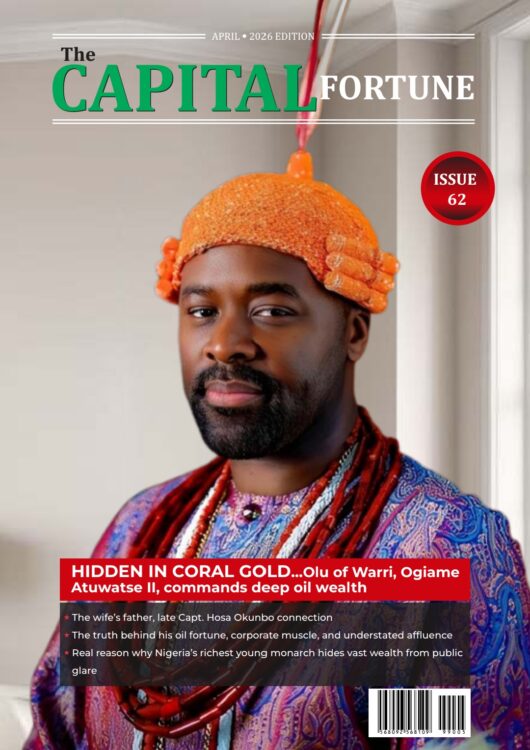
-The wife’s father, late Capt. Hosa Okunbo connection
-The truth behind his oil fortune, corporate muscle, and understated affluence
-Real reason why Nigeria’s richest young monarch hides vast wealth from public glare
By Micheal Ojo
A certain stillness surrounds true wealth. It does not clatter. It does not announce itself with vulgar noise or restless display. It moves quietly, like deep water. It is felt more than seen, and powerful without spectacle. That stillness hangs about Ogiame Atuwatse III, the 21st Olu of Warri, whose reign has come to embody a rare synthesis of immense private fortune and public restraint.
Estimates place his wealth in the region of $30 million (thirty million dollars), a figure uttered across corridors of influence and repeated with the careful reverence reserved for men who command both capital and culture. Among Nigeria’s traditional rulers, his name sits comfortably at the summit of youthful affluence. Yet nothing in his bearing clamours for attention. His wealth, like his speech, carries a measured cadence. It is disciplined and almost austere.
His fortune, even in its most disciplined expression, however, bears the imprint of timely guidance and strategic patronage. For Ogiame Atuwatse III, an early and decisive opening came through the confidence reposed in him by his late father-in-law, Captain Hosa Okunbor, whose influence within the oil and gas ecosystem proved catalytic. Hence, his fast rise in the oil industry wasn’t solely an individual effort. He received very beneficial head-start from his late father-in-law, Capt. Okunbo.
It was under this canopy of trust that he assumed administrative stewardship of Ocean Marine, a maritime security and logistics concern that would, in time, evolve into Pipeline Infrastructure Nigeria Limited. That inheritance of responsibility demanded more than proximity to power; it required acuity, discipline, and the capacity to navigate a sector defined by complexity and high stakes.
He rose to that demand with tenacity, refining operations, strengthening institutional structure, and expanding its commercial reach until the firm emerged as a formidable enterprise and a reliable revenue engine. The trajectory bears the marks of both mentorship and merit—an early platform provided by experience, and a sustained ascent powered by his own industry—culminating in a position of commanding relevance within the oil economy, where the enterprise now generates significant monthly inflows measured in millions of dollars.
August 21, 2021, marked his ascension to the ancient throne of the Warri Kingdom, a moment that gathered centuries into a single breath. Ode-Itsekiri bore witness as Utieyinoritsetsola Emiko became Ogiame Atuwatse III, stepping into a lineage that has shaped the political and cultural landscape of the Niger Delta for generations. Age thirty-seven then, he entered kingship with the poise of one already acquainted with power, its burdens, and its illusions.
His early life prepared him for this convergence of history and responsibility. Born into royalty and nurtured within the disciplined traditions of the Itsekiri court, he absorbed lessons that spoke of dignity, restraint, and service. Education widened his horizon without erasing his roots. From Warri to Offa, and onward to Case Western Reserve University in the United States, his intellectual journey carved a global perspective into a mind already steeped in ancestral wisdom. Degrees in International Studies, Political Science, and Management sharpened his understanding of systems, governance, and enterprise.
Corporate life followed, not as ornament but as proving ground. He built ventures, chaired companies, and navigated the intricate waters of maritime security and energy logistics. Noble Nigeria Limited and Coral Curator Limited bore his entrepreneurial imprint. Leadership roles in Ocean Marine Security Limited, Gulf of Guinea Limited, and Vessellink Nigeria Limited placed him at the intersection of commerce and national infrastructure. Each engagement refined a sensibility that now shapes his kingship, a sensibility that views wealth as instrument, not indulgence.
That philosophy reveals itself in the hghlights of his reign. Assets under his influence stretch across traditional and modern domains, yet their purpose aligns with a singular vision: development anchored in dignity. Royal regalia gleams with centuries of heritage; ceremonial boats cut through the creeks with quiet authority; a white Rolls-Royce appears during state occasions, stately yet restrained. Palaces stand as custodians of history rather than monuments to excess. Even moments of modernity, such as his occasional public rides on a scooter, carry an understated ease that resists theatricality.
Financial strength finds its most compelling expression in deliberate acts of investment. The Iwere Development Trust Fund, launched with a personal contribution of N750 million, stands as testament to a philosophy that places communal uplift at the centre of wealth. The gesture carried neither flourish nor fanfare beyond its intrinsic significance. A king placed his resources at the service of his people, setting a tone that calls others to similar responsibility.
Words spoken during that moment linger with quiet force. Reconciliation, he declared, rests upon repentance. Unity grows from sincerity. Those gathered heard not merely a ceremonial address but a moral proposition, a reminder that wealth without cohesion yields little lasting value. His appeal extended across the diaspora, summoning Itsekiri sons and daughters toward a renewed collective purpose.
Economic vision threads through his engagements with remarkable consistency. Warri Kingdom, seated upon vast oil and gas reserves, holds strategic importance within Nigeria’s energy architecture. He approaches this reality with a careful blend of advocacy and diplomacy, engaging stakeholders across the industry—Chevron, Renaissance, Heritage, Conoil—seeking outcomes that honour both resource wealth and community welfare. His voice carries weight in these conversations, shaped by firsthand experience within the sectors under negotiation.
Investment promotion forms another pillar of his approach. The Iwere Economic Summit, convened under his leadership, signalled an openness to foreign capital and global partnerships. Here again, restraint defines his method. The language of invitation avoids desperation; it speaks instead from a position of quiet confidence, aware of the kingdom’s intrinsic value.
Social impact initiatives extend this philosophy into tangible outcomes. Modern schools rise within the kingdom, equipped with materials that bridge educational gaps. Health centres emerge where neglect once lingered, bringing medical expertise into underserved communities. These interventions do not parade themselves as charity. They function as obligations, extensions of a covenant between throne and people.
His partnership with Olori Atuwatse III adds further dimension to this evolving narrative. Educated, accomplished, and deeply engaged, she occupies a role that reflects both continuity and transformation within the institution. Her presence beside him during ceremonies signals an intentional recalibration of royal dynamics, one that embraces collaboration and shared purpose.
Yet amid these layers of influence, what remains most striking is the discipline of understatement. Wealth, in many contemporary expressions, seeks validation through visibility. It thrives on exhibition, on the spectacle of possession. His approach moves in the opposite direction. Affluence resides in structure rather than display, in impact rather than impression.
Even controversies that brush against his orbit encounter this composure. Claims linking him directly to pipeline surveillance contracts have been publicly contested and clarified. Statements from community leaders draw clear distinctions between vested interests and ownership, reinforcing a narrative grounded in transparency. Through it all, his demeanour remains unchanged. It stays measured, focused, and undistracted.
This equilibrium between wealth and restraint speaks to a deeper inheritance. Aristocracy, in its truest form, rests upon codes that transcend currency. It demands discipline, a certain quiet confidence that does not seek external affirmation. Within that tradition, display yields to dignity; excess bows to purpose. Ogiame Atuwatse III embodies this ethic with remarkable consistency.
Cultural preservation finds renewed energy under his watch. Festivals reclaim their vibrancy; historical narratives receive fresh articulation; global platforms become avenues for cultural diplomacy. Engagements with international figures, including royalty and statesmen, position the Warri Kingdom within broader conversations about heritage and modernity. Each interaction reinforces a dual identity that is firmly rooted and outward-looking.
Age adds a further layer of intrigue. At forty-one, he stands at a generational crossroads, carrying ancient authority within a contemporary frame. His decisions resonate across timelines, shaping futures while honouring pasts. Youth, in his case, does not dilute gravitas. It sharpens it, infusing traditional leadership with renewed energy.
The Niger Delta itself provides context to this unfolding story. A region marked by immense resource wealth and enduring challenges demands leadership that understands both its promise and its complexities. His familiarity with its economic engines, coupled with an intimate connection to its cultural fabric, positions him uniquely within this landscape.
Reconciliation efforts within the kingdom illustrate a nuanced understanding of leadership. Acknowledging grievances, calling for repentance, and extending an open door, these gestures reflect a willingness to engage complexity without surrendering authority. Peace, in his articulation, requires structure, sincerity, and sustained commitment.
Community organisations respond in kind. The establishment of an Information Technology Resource Centre in Ode-Itsekiri by the Itsekiri Renaissance Group signals alignment with his developmental vision. Initiatives such as these amplify the reach of his agenda, creating networks of progress that extend beyond the palace.
Philanthropy, in this context, acquires a distinctive tone. It resists sentimentality. It favours strategy. Interventions target structural deficiencies encompassing education, healthcare, and economic opportunity, seeking durable transformation rather than fleeting relief. This approach reflects the analytical training of a corporate strategist fused with the moral obligations of kingship.
Across Nigeria, conversations about wealth often carry undertones of suspicion or spectacle. Narratives oscillate between admiration and critique, frequently anchored in visible excess. His example introduces an alternative vocabulary. Wealth, here, aligns with stewardship. Visibility yields to impact. Silence acquires its own eloquence.
Observers who encounter him frequently remark upon this quality. Presence without ostentation. Authority without aggression. Confidence without noise. These attributes shape interactions, creating an atmosphere where influence operates subtly yet decisively.
Even symbols associated with his office adopt this character. The Rolls-Royce, gleaming during ceremonial appearances, does not dominate the narrative. It serves its purpose, then recedes. Royal boats glide across waterways, functional yet emblematic. Palaces stand, dignified, without descending into extravagance. Each element aligns with a broader ethos of measured expression.
Economic initiatives continue to unfold under his guidance. Efforts to attract foreign direct investment gain momentum, supported by a network of relationships cultivated over the years within corporate and diplomatic circles. Warri Kingdom emerges as a destination defined by opportunity and stability, its narrative reshaped through deliberate engagement.
Within this evolving landscape, the figure of Ogiame Atuwatse III remains central. A monarch whose wealth commands attention, whose restraint commands respect, whose vision commands participation. His story unfolds as a study in balance, a careful orchestration of power, purpose, and principle.
Time will inevitably test the durability of this model. Challenges will arise, shaped by economic shifts, political dynamics, and the inherent complexities of leadership. Yet the foundations laid thus far suggest a resilience anchored in clarity of purpose.
Quiet wealth, when guided by disciplined intent, builds, restores, and redefines without surrendering to spectacle. In Warri Kingdom, that principle finds living expression within a monarch who understands that the truest measure of affluence lies not in its display but in its deployment.
Across the creeks and communities of the Niger Delta, that understanding continues to ripple outward, shaping lives, inspiring confidence, and redefining expectations.
Thus, the story of Ogiame Atuwatse III, the 21st Olu of Warri, resists easy categorisation. It belongs neither wholly to tradition nor entirely to modernity. It inhabits the fertile space between them, where evolution occurs.
Observers may continue to quantify his wealth, assign rankings, and compare fortunes. Such exercises capture only fragments of a larger reality. His true currency lies elsewhere, in influence, impact, and steady transformation of his kingdom.
Gold gleams softly in his world. Power speaks in measured tones even as wealth finds dignity in silence. And within that silence, a new model of monarchy takes shape. It is refined, deliberate, and wholly enduring.