
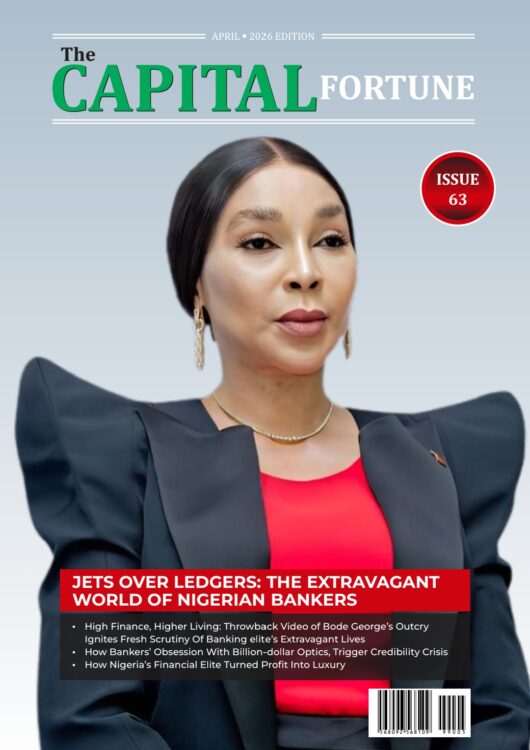
● High Finance, Higher Living: Throwback Video of Bode George’s Outcry Ignites Fresh Scrutiny Of Banking elite’s Extravagant Lives
●How Bankers’ Obsession With Billion-dollar Optics, Trigger Credibility Crisis
● Banking On Excess: How Nigeria’s Financial Elite Turned Profit Into Luxury
A republic of glass towers and guarded gates rises across Nigeria’s financial capitals, its skyline punctuated by logos that promise trust, discipline, and stewardship. Beneath those emblems, a quieter spectacle unfolds: sleek fuselages on private tarmacs, champagne-lit cabins slicing through dusk, an aristocracy of finance borne aloft on engines of privilege.
Chief Bode George forced that spectacle into public view, in 2024, dragging the velvet curtain aside with a question as blunt as it is unsettling: how did custodians of depositors’ funds come to inhabit a lifestyle that mirrors oligarchs, not bankers? His condemnation stirred an old anxiety back to life—an anxiety about the distance between the ethics of banking and the excesses of those who run it.
Just recently George’s take on the malady assumed front burner of public discourse, particularly in the wake of a revelation few days ago, that late Managing Director/Chief Executive Officer (MD/CEO) of Access Bank, Herbert Wigwe, owned 106 high-value London Properties. The former chief executive of Access Bank stood connected to 106 properties scattered across the British capital. No allegation of wrongdoing accompanies the revelation. Yet the sheer scale alters perception, reframing a life already celebrated in boardrooms and business pages. It also redirects attention toward the unseen reservoirs of private fortune within one of Africa’s most powerful financial institutions.
As the news of Wigwe’s 106 properties went viral, a throwback video of George’s statement on bankers’ lavish lifestyle, went viral for the umpteenth time, triggering yet another round of debate among netizens and stakeholders in the banking sector.
George spoke of dollars “released monthly,” and of a system that allegedly fed insiders while the broader economy starved. He wondered aloud how executives ascended from modest beginnings to command fortunes vast enough to purchase jets, banks, and even universities.
His accusations, directed at figures such as the late Herbert Wigwe and former Central Bank governor Godwin Emefiele, have split public opinion. Admirers of Nigeria’s banking elite point to their global expansions and philanthropic gestures. Critics see a pattern of opulence that mocks the very prudence banking demands. Between both camps lies a deeper question, one that refuses easy dismissal: can a system entrusted with safeguarding public wealth afford leaders whose lifestyles suggest a different allegiance?
Private aviation has become the most visible emblem of this debate. On runways from Lagos to Abuja, aircraft bearing no commercial insignia wait in discreet corners, engines idling for journeys whose costs rarely enter public discourse. Ownership records remain opaque, leasing arrangements shield details, yet the symbolism remains stark.
Bank executives, once figures defined by restraint and discretion, now move with the velocity of sovereign wealth. Corporate retreats unfold in distant continents. Meetings convene at altitudes where the hum of engines drowns out the anxieties of a struggling naira.
The optics have grown impossible to ignore. A nation wrestling with inflation, currency volatility, and unemployment watches as its financial stewards ascend into rarified air. The contrast has sharpened into a moral inquiry: does such extravagance erode the fragile covenant between banks and the public they serve?
George spoke of “round-tripping,” a term that has haunted Nigeria’s financial vocabulary for decades, an allegation that foreign exchange allocations were diverted and resold for profit.
His critique did not stop at mechanisms. It also probed character. Bank managing directors, he argued, have embraced a lifestyle alien to their counterparts in other financial centers. He invoked comparisons with executives in the United States, the United Kingdom, Canada, Germany, and the United Arab Emirates, jurisdictions where, in his telling, restraint still governs conduct.
His most piercing question lingered: where did the money come from?
That question, repeated across newsrooms and social media feeds, has become a refrain in a country weary of unexplained wealth. It has also exposed a tension within Nigeria’s narrative of success. Banking, once celebrated as a pathway to disciplined prosperity, now risks association with sudden, spectacular enrichment.
The passing of Herbert Wigwe in early 2024 equally cast a long shadow over these debates. Wigwe had embodied the ambition of Nigeria’s modern banking era, a figure who transformed Access Bank into a continental powerhouse. His legacy included financial expansion, cultural and educational ventures, among them the ambitious Wigwe University project.
George’s remarks, arriving in the wake of Wigwe’s death, struck many as ill-timed. Defenders rallied, citing Wigwe’s achievements, philanthropy, and role in projecting Nigerian banking onto the global stage. They argued that wealth, in his case, reflected years of disciplined strategy and calculated risk.
Yet the discomfort persisted. Wigwe’s story, celebrated and scrutinized in equal measure, became a prism through which the broader question of bankers’ wealth could be examined. His life illustrated both the possibilities of financial leadership and the suspicions that accompany extraordinary success in a fragile economy.
Attention soon turned to the tenure of Godwin Emefiele at the helm of the Central Bank of Nigeria. George accused the former governor of fostering an environment that enabled abuse, a system where regulatory authority blurred into commercial advantage.
Under Emefiele, the Central Bank pursued policies that sought to stabilize the currency and support local industries. Critics, however, argued that these policies created opportunities for arbitrage. The gap between official and parallel market exchange rates became a fertile ground for speculation.
George’s allegation, that bank executives received dollars only to resell them at higher rates, echoed long-standing concerns about transparency in forex allocation. Whether proven or not, such claims resonate in a country where currency instability has become a daily burden.
Nigeria’s banking sector has reported robust profits in recent years, buoyed by foreign exchange revaluations and interest income. Annual reports showcase billions in earnings, figures that inspire both admiration and suspicion.
For critics like George, these profits raise uncomfortable questions. He points to hidden charges, insider dealings, and systemic advantages that tilt the field in favor of banks. He sees a sector extracting value from an economy already stretched thin.
For defenders, the narrative differs. Banks operate within regulatory frameworks, they argue, and their profits reflect strategic positioning in volatile markets. They highlight the sector’s role in financing infrastructure, supporting businesses, and facilitating trade.
The truth lies tangled between these perspectives. Profit, in itself, carries no moral stain. Perception, however, shapes public trust. When profits coincide with conspicuous luxury, perception hardens into suspicion.
Amid the rising debate, Femi Otedola introduced a striking statistic: Nigerian banks, he claimed, spend roughly $50 million annually on maintaining private jets. The figure landed with the force of revelation, offering a concrete measure of the extravagance critics had long suspected.
Otedola, chairman of FBN Holdings, did not couch his words in ambiguity. He criticized the scale of expenditure, describing it as misaligned with the sector’s responsibilities. His remarks added weight to calls for reform, reinforcing the argument that excess within banking carries broader economic consequences.
His support for a windfall tax further sharpened his stance. Extraordinary profits, he argued, demand extraordinary contributions to society. Revenue from such taxes could fund healthcare, education, and infrastructure, areas where Nigeria’s needs remain urgent.
Legislative action soon followed. In July 2024, the Senate amended the Finance Act, imposing a 70 percent windfall tax on banks’ foreign exchange profits. The policy aimed to capture gains generated by currency volatility and redirect them toward national priorities.
The tax signaled a shift in government posture, a willingness to confront the banking sector’s outsized gains. Supporters hailed the move as overdue. They saw it as a mechanism to restore balance, ensuring that windfalls benefit the wider population. Critics warned of unintended consequences, arguing that excessive taxation could deter investment and strain financial institutions.
Yet beneath these arguments lies a shared recognition: the relationship between banks and society demands reconsideration.
Banking rests on trust. Depositors entrust their savings to institutions that promise safety, prudence, and integrity. Investors rely on transparent governance. Regulators enforce standards designed to prevent excess and abuse.
Extravagant lifestyles, however, challenge these foundations. When bank executives appear detached from the economic realities faced by ordinary citizens, trust erodes. A private jet, no matter how justified by business needs, carries symbolic weight in a country grappling with inequality.
The tension between necessity and excess defines this moment. Corporate leaders may argue that efficiency and security justify private aviation. Critics counter that frequency and scale suggest indulgence.
The debate extends beyond jets. It encompasses luxury real estate, exclusive events, and a culture of display that seems at odds with the ethos of banking. Each visible sign of wealth invites scrutiny, each unanswered question deepens doubt.
George’s critique hints at a deeper concern: a culture where accountability falters. He speaks of insider abuse and fraudulent charges, suggesting systemic weaknesses that allow excess to flourish. Such allegations resonate within Nigeria’s broader struggle against corruption, and financial institutions occupy a critical position in that struggle.
Calls for investigation have grown louder. George has urged the government to probe the banking sector, to examine the sources of wealth and the structures that sustain it. His proposal for a special fund, requiring bank executives to contribute substantial sums annually, reflects a desire to translate criticism into policy.
Whether such measures gain traction remains uncertain. Their very articulation, however, signals a shift in public discourse.
Some commentators have dismissed them as reckless, arguing that they undermine confidence in a sector vital to economic stability.
Others insist that the questions raised deserve thorough investigation. Transparency, they argue, benefits both banks and the public. Clarifying the sources of wealth and the legitimacy of practices could restore trust.
Institutions themselves carry a responsibility to demonstrate integrity. Public reaction to George’s remarks has revealed a deep reservoir of frustration. Social media platforms have become arenas of debate, where citizens dissect the lifestyles of banking executives and the policies that enable them.
Some voices defend the sector, highlighting its achievements and resilience. Others express anger, viewing bankers as symbols of inequality. This polarization reflects broader tensions within Nigerian society. Economic hardship has sharpened sensitivity to displays of wealth. Trust in institutions has eroded under the weight of past disappointments.
Reform, if it comes, will require more than rhetoric. It will demand structural changes, enhanced regulatory oversight, stricter transparency requirements, and a cultural shift within the banking sector itself.