
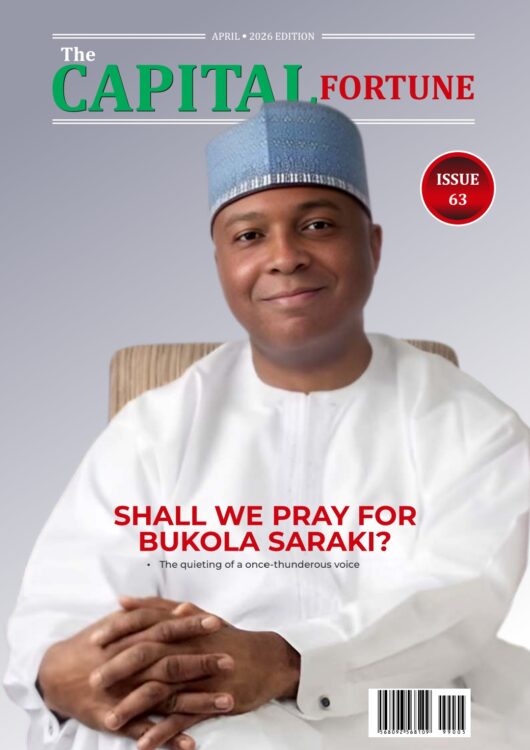
● The quieting of a once-thunderous voice
There was a time when the name Bukola Saraki carried the kinetic force of a gathering storm. It moved through corridors of power with a peculiar assurance, stirring both allegiance and unease, admiration and calculation. It commanded rooms, bent trajectories, and compelled history to pause, if only briefly, to take note. That time now feels like a distant echo, audible, yet faint; present, yet receding into the long corridor of political memory.
A question hangs in the air, delicate yet insistent: Shall we pray for Bukola Saraki?
This is neither mockery nor malice. It rises from a place of bewilderment, tinged with reverence. It is the kind of question uttered when a flame once bright begins to flicker in ways that unsettle those who remember its former blaze. It is the lament of a political class, and a nation, that has grown accustomed to his fire, and now finds itself tracing its absence with uneasy fingers.
Silence has a language. It speaks through absence, through restraint, through the spaces where sound once lived. Saraki’s current posture within Nigeria’s political space feels defined by such silence. It is not the contemplative quiet of a strategist biding his time; it carries the texture of withdrawal, of a presence that has chosen the shadows over the stage.
Memory refuses to cooperate with this present reality. It insists on recalling a different figure entirely; a man whose political instincts seemed sharpened by adversity, whose movements suggested an unspoken mastery of timing and leverage. That Saraki did not recline into oblivion; he was outspoken and assertive. He did not hover at the margins; he occupied the centre with a confidence that felt almost elemental.
Kwara State, once the intimate theatre of his dominance, now echoes with a different cadence. The familiar rhythm of his political orchestration has grown faint. Structures that once moved at his signal now appear to operate with a diminished sense of urgency, as though awaiting a conductor who has stepped away from the podium without explanation.
Nationally, the silence feels even more pronounced. Political seasons in Nigeria are rarely gentle; they demand voices, they reward presence, they elevate those who seize the moment with audacity. Yet, within this restless cycle, Saraki has chosen an almost monastic restraint. The absence is striking because it stands in sharp contrast to the memory of a man who once thrived in the very turbulence that now unfolds without him.
Questions multiply in the vacuum. What force compels such reticence? What calculus dictates this withdrawal? Fear feels too simplistic an answer for a figure whose political journey has been defined by confrontation and resilience. Compliance, too, seems insufficient to explain a silence so complete, so sustained. The mind reaches for explanations and finds itself circling possibilities without landing on certainty.
Those who remember his tenure as Senate President recall a period marked by a rare assertiveness within the legislative arm. The National Assembly, under his watch, projected an independence that unsettled the executive and redefined the balance of power. It was a season of calculated defiance, where strategy met courage in a manner that elevated governance beyond routine compliance.
That era was the product of a mind attuned to the subtleties of power, a leader capable of navigating complexity without surrendering initiative. Saraki’s leadership during those years bore the imprint of intentionality. Decisions carried weight; actions reverberated with consequence.
Today, that same political terrain feels altered, not merely by the passage of time, but by the absence of a voice that once shaped its contours. The Senate has moved on, as institutions inevitably do, yet the comparison lingers in quiet conversations and reflective analyses. Something essential appears to have receded, leaving behind a space that feels inadequately filled.
Within the broader circuit of Nigerian politics, influence rarely disappears; it transforms, relocates, and disguises itself in new forms. Yet Saraki’s current disposition suggests something different, a deliberate disengagement that resists easy categorisation. It does not carry the energy of reinvention; it feels closer to suspension, a pause extended beyond its expected duration.
All political careers encounter moments of renewal. The arc of power is rarely linear; it bends, it dips, it ascends in rhythms that defy prediction. Saraki’s journey has known such fluctuations before. Setbacks have punctuated his ascent, yet each time, he returned with a renewed sense of purpose, a recalibrated strategy that restored his relevance.
This moment feels distinct. It carries a depth of quiet that invites deeper scrutiny. It raises the possibility of a transformation unfolding beneath the surface, unseen yet consequential. It also raises the more unsettling prospect of a retreat that may not reverse itself.
Observers within Kwara speak in measured tones about the shift. The once palpable energy that defined Saraki’s political machinery has softened. Engagements appear less frequent, interventions less decisive. The intimacy that once characterised his relationship with the state’s political ecosystem feels altered, as though distance has introduced a new cadence into that interaction.
National allies, too, appear to navigate this silence with a mixture of caution and curiosity. Political partnerships thrive on visibility, on signals that affirm alignment and intent. Saraki’s current posture offers few such signals. It leaves room for interpretation, for speculation, for the kind of uncertainty that politics instinctively resists.
Yet, beneath the surface of this silence, admiration persists. It refuses to dissipate. It anchors itself in the memory of what has been achieved, in the recognition of a political intellect that once operated with remarkable clarity. That admiration fuels the question at the heart of this narrative, not as a dismissal, but as an invocation.
Shall we pray for Bukola Saraki? Prayer, within this context, transcends its religious connotation. It becomes a metaphor for hope, for the desire to witness a rekindling, a resurgence that restores balance to a political landscape that feels diminished in his absence. It reflects a collective yearning for the return of a voice that once enriched the national conversation with its force and precision.
Nigeria’s political environment thrives on contestation. It demands figures capable of articulating alternative visions, of challenging prevailing narratives, of expanding the scope of possibility. Saraki’s silence deprives this environment of one such figure. It narrows the field in subtle yet significant ways.
History often revisits its protagonists with renewed interest during moments of quiet. It examines their trajectories, it reassesses their contributions, it situates their legacies within evolving contexts. Saraki’s current phase invites such reflection. It compels a re-engagement with the story of a man whose political journey has intersected with some of the most defining moments in Nigeria’s recent history.
That story remains unfinished. Its next chapter has yet to declare itself. The silence that defines the present may well be the prelude to a resurgence that defies current expectations. It may also mark a transition into a different mode of influence, less visible yet equally significant.
For now, the question endures. It lingers in conversations, in analyses, in the quiet spaces where politics intersects with memory and hope.
Shall we pray for Bukola Saraki?
The answer may lie not in the silence that surrounds him, but in the possibility that within that silence, a new fire gathers unseen, patient, awaiting its moment to flare once more.