

● BUA partners AD Ports, MAIR to refine Nigerian sugar in Abu Dhabi
● Deal positions Khalifa Port as hub for Middle East, Asia exports
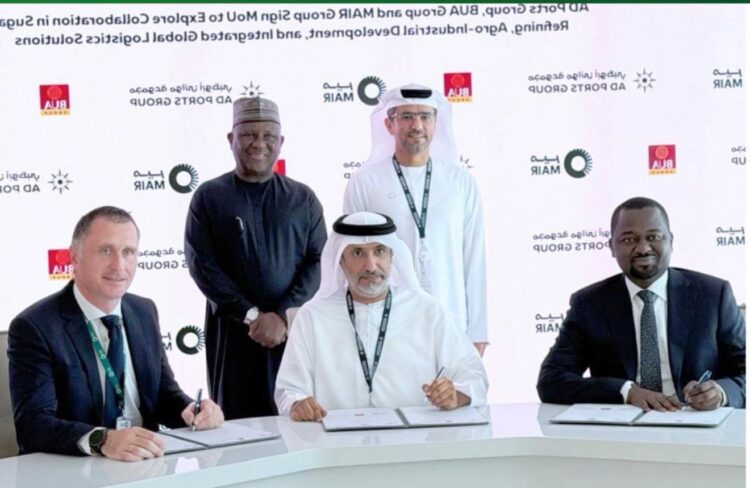
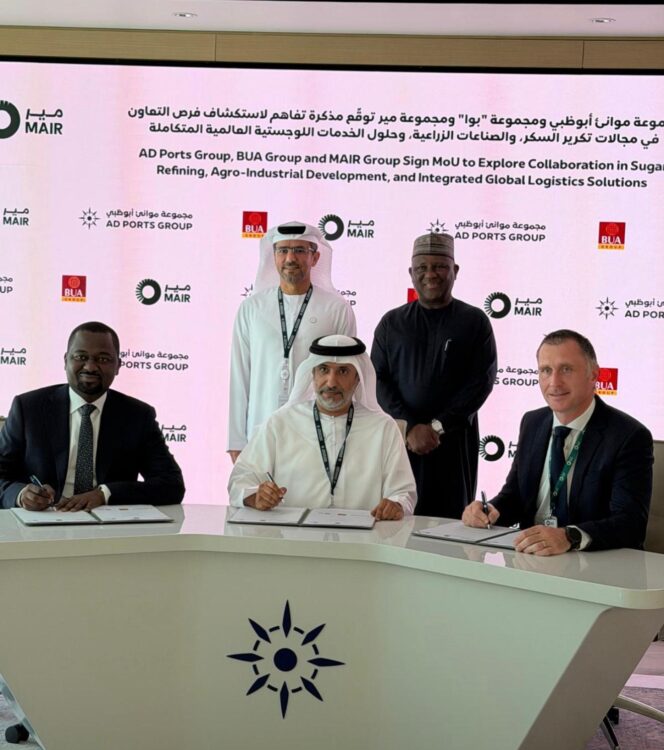
Steel-blue waters glinted beneath the Arabian sun as signatures charted a fresh cartography of trade between West Africa and the Gulf. Across polished tables in Abu Dhabi, a Nigerian conglomerate pressed its ambition into maritime history, binding sugar fields in Kano and refinery lines along the Niger to one of the world’s most strategic ports. The document bore formal language—Memorandum of Understanding—yet its implications boomed with the import of a continental pivot.
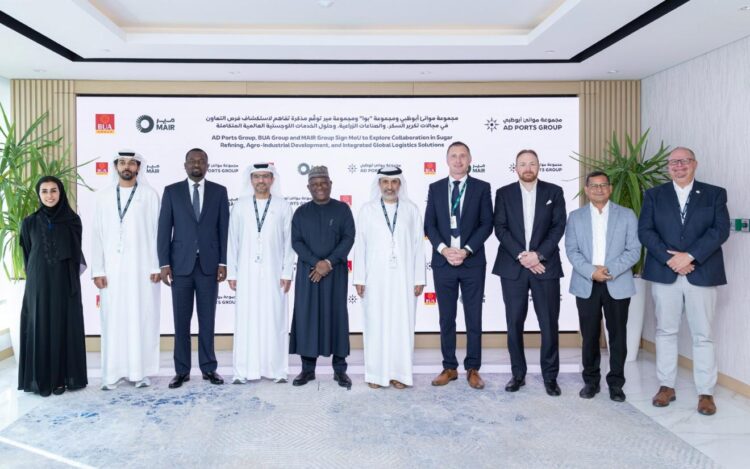
At the centre of that moment stood Abdulsamad Rabiu, founder and chairman of BUA Group, guiding his company into partnership with AD Ports Group and MAIR Group to establish a Nigeria–UAE sugar exports corridor anchored at Khalifa Port. Agricultural commodities cultivated on Nigerian soil will travel across seas to Abu Dhabi, where refining, storage and redistribution will channel them into markets across the Middle East and Asia. Commerce acquired a new route; diplomacy acquired a fresh texture; Nigeria acquired a platform with reach measured in oceans.
Khalifa Port hums with the tempo of global exchange. More than twenty-five major shipping lines dock along its berths. Seventy destination ports connect through its arteries. Containers glide through its terminals with clockwork precision, each one carrying a fragment of the global appetite. Within that choreography of cranes and cargo, Nigerian sugar will now find passage, processed and re-exported under a framework aligned with the UAE’s Food Security Strategy 2051.
That strategy seeks durable supply chains, domestic processing strength, and insulation from volatility in finished food imports. Rabiu’s agreement folds Nigerian production into that ambition. Fields in northern Nigeria gain a corridor that stretches into Gulf markets; refineries in Abu Dhabi gain consistent input from West Africa; consumers across Asia and the Middle East encounter supply anchored in coordinated logistics.
Structure defines this partnership. AD Ports contributes infrastructure that links continents. MAIR Group, a UAE-based strategic investment firm focused on the food industry, channels local expertise and capital discipline. BUA brings industrial depth earned through decades of refining sugar, milling flour, and manufacturing cement across Nigeria. Three institutions converge with complementary strengths, crafting a platform for production, storage and distribution that reflects deliberate alignment.
Rabiu’s remarks at the signing carried the cadence of long-term intent. The MoU, he said, marks an important milestone in BUA’s international expansion and aims to develop sustainable food production and logistics solutions that strengthen regional supply chains. Language of sustainability and resilience signals a mindset attuned to the evolving demands of global commerce, where reliability commands premium value.
Context amplifies the resonance of the deal. Nigeria and the United Arab Emirates recently sealed a Comprehensive Economic Partnership Agreement eliminating tariffs on more than 7,000 products. Agricultural goods sit prominently within that list. The Ministry of Marine and Blue Economy in Nigeria also signed a separate memorandum with AD Ports to explore port efficiency, logistics connectivity, maritime services and digital trade infrastructure. Policy frameworks thus form a lattice around private initiative, reinforcing a shared trajectory.
President Bola Tinubu described the BUA agreement as a tangible dividend of strengthened diplomatic ties and expanding economic cooperation. His words illuminate a broader theme: trade corridors function as arteries of statecraft. Corporate signatures carry diplomatic undertones; commercial routes influence geopolitical balance. Rabiu’s corridor embodies that intersection.
Nigeria’s agricultural sector has long faced persistent instability arising from price volatility, weak transport infrastructure and fragmented export systems that make it difficult for producers to plan with certainty. These constraints have limited the sector’s ability to scale and compete effectively in international markets. The establishment of a structured export channel anchored at Khalifa Port introduces a measure of predictability that has often been absent. With a defined logistics and processing destination in place, farmers gain clearer visibility into demand cycles, financial institutions are better positioned to assess risk, and policymakers can reference a working model of export-led industrial coordination.
Sugar occupies a central place in this development because it represents both an agricultural product and an industrial commodity with multiple stages of value addition. In northern Nigeria, sugarcane cultivation supports thousands of livelihoods, while refineries in Lagos and other industrial centres transform raw input into finished products for domestic consumption. BUA Group has invested extensively in backward integration, expanding plantation capacity and strengthening refining operations. The Abu Dhabi corridor extends that value chain beyond national borders, linking Nigerian production to a global redistribution hub with established access to high-growth markets.
By integrating Nigerian output into processing and distribution systems in the Gulf, the agreement reshapes the country’s participation in the global food economy. Refined sugar processed in Abu Dhabi can be routed efficiently to markets across Asia and the Middle East, where logistics networks are optimised for large-scale transshipment. Greater routing efficiency reduces delays and improves cost competitiveness, which in turn enhances revenue prospects throughout the supply chain. As a result, Nigeria’s agricultural exports can move within a framework designed for scale and sustained market access.
Industry observers note that Abdulsamad Rabiu’s business trajectory reflects a consistent emphasis on integration and sequencing. His investments in cement were aligned with proximity to limestone deposits, while flour milling operations leveraged both imported grain channels and domestic cultivation. Sugar refining connected plantation development with industrial processing. Each expansion phase followed a structured pattern designed to consolidate capacity before pursuing further growth. The Gulf corridor aligns with this approach by linking established domestic operations to an international logistics platform.
The strategic dimension of the partnership becomes clearer when viewed through the role of AD Ports Group, which manages ports and logistics zones across several geographies. Its infrastructure at Khalifa Port provides access to a sophisticated ecosystem built for speed, efficiency and compliance with global standards. MAIR Group, a UAE-based investment firm focused on advancing the country’s food industry, brings local market knowledge and financial coordination. Together with BUA’s industrial capacity, the collaboration establishes a platform designed for long-term sustainability.
Khalifa Port’s operations illustrate the scale of the opportunity. The port serves more than twenty-five major shipping lines and connects to over seventy destinations worldwide, positioning it as a strategic node linking Africa, Asia and Europe. Nigerian sugar shipments routed through this hub will be processed, stored and redistributed within a system that prioritises efficiency and global reach. The arrangement ensures that export volumes from Nigeria can be integrated into established trade routes with minimal logistical friction.
Each shipment under the proposed corridor reflects coordinated activity across multiple locations. Farmers in northern Nigeria adjust production cycles to meet export commitments, port operators in Lagos manage loading and documentation, and logistics teams in Abu Dhabi oversee refining and onward distribution. The agreement therefore functions as a multi-layered enterprise that connects agricultural producers, industrial processors and maritime operators within a unified commercial framework.
Economic analysts often emphasise that infrastructure determines competitive advantage in global trade. Ports, transport corridors and processing facilities influence both speed and cost, shaping how effectively goods reach international markets. By embedding its operations within Khalifa Port’s infrastructure, BUA situates Nigerian agricultural output within a logistics system central to twenty-first-century trade flows. This positioning enhances the country’s ability to compete in markets where reliability and efficiency are decisive factors.
Some commentators have raised questions about overseas refining arrangements, arguing that domestic processing should remain the sole focus. However, diversified processing locations can strengthen resilience by reducing exposure to local disruptions and expanding access to foreign markets. Strategic cross-border integration allows companies to balance domestic production with international distribution, thereby mitigating operational risks while broadening revenue streams.
BUA’s diversified portfolio across sugar, flour and cement underscores its operational depth within Nigeria. These industries generate employment and stimulate ancillary sectors such as transport, packaging and retail. The Gulf corridor complements this domestic base by adding international reach, enabling the company to diversify income sources and enhance brand visibility in global markets.
The timing of the agreement aligns with broader diplomatic developments. The Comprehensive Economic Partnership Agreement between Nigeria and the UAE eliminates tariffs on more than 7,000 products, including agricultural goods, thereby facilitating smoother cross-border trade. In addition, Nigeria’s Ministry of Marine and Blue Economy recently signed a separate memorandum with AD Ports Group to explore improvements in port efficiency and digital trade infrastructure. Corporate and governmental initiatives therefore converge around a shared objective of enhancing logistics and economic cooperation.
President Bola Tinubu characterised the BUA agreement as a tangible dividend of strengthened diplomatic ties and expanding economic cooperation between the two countries. His remarks underscore the macroeconomic implications of such corridors, which can influence foreign exchange earnings, trade balances and industrial output. Structured export channels are increasingly viewed as instruments of national development strategy.
The UAE’s Food Security Strategy 2051 provides the long-term policy framework underpinning the corridor. Heightened global awareness of supply chain vulnerability, driven by climate change, geopolitical tensions and pandemic disruptions, has prompted governments to prioritise stable sourcing arrangements. Nigeria’s agricultural capacity, integrated through BUA’s operations, offers a complementary supply stream that supports the UAE’s objectives while expanding Nigeria’s export footprint.
Within Nigeria, stakeholders anticipate that the structured export pathway could stimulate further investment in irrigation systems, mechanisation and yield improvement. Greater certainty in export demand may encourage the formation of agricultural clusters oriented toward international markets, strengthening rural economies and creating new employment opportunities.
Financial analysts point out that the memorandum of understanding does not yet specify capital commitments, as the parties intend to negotiate a full joint venture agreement. This phased approach reflects a deliberate strategy in which framework alignment precedes large-scale investment. Careful sequencing allows for detailed due diligence and governance structuring before funds are deployed.
The announcement has generated considerable interest within Nigerian business circles, where export diversification remains a priority. While imagery of ships and refineries captures public imagination, industry participants focus on practical considerations such as freight costs, processing margins and supply volumes. The corridor’s success will ultimately depend on disciplined execution and market responsiveness.
Sugar’s journey from plantation to consumer illustrates the layered nature of value addition. Harvesting, milling, refining, packaging and distribution each contribute incremental economic gains. Coordinating these stages across national borders requires logistical precision and regulatory compliance, both of which are facilitated by integration within established hubs such as Khalifa Port.
Maritime cooperation between Nigeria and the UAE signals broader ambitions to upgrade port efficiency and digital trade systems. Improved customs processes and modernised logistics platforms can enhance competitiveness for a wide range of exports beyond sugar. The corridor may therefore serve as a template for additional commodity partnerships.
Rabiu’s career trajectory mirrors this progression from local enterprise to global integration. Expanding BUA from trading roots into a diversified industrial conglomerate involved disciplined financing, incremental scaling and strategic alliances. The Gulf corridor represents an extension of that strategy into international logistics architecture.
Foreign investors evaluating such partnerships typically scrutinise governance standards and operational capacity. BUA’s ability to secure collaboration with established entities like AD Ports and MAIR suggests confidence in its institutional robustness and compliance frameworks. Reputation remains a critical asset in cross-border ventures.
Trade flows also influence national perception. Regular shipments of Nigerian agricultural products through major international ports reinforce an image of productive capacity and reliability. Consistent performance in export commitments strengthens the country’s standing within global commerce.
The corridor contributes to a broader narrative about Africa’s evolving role in global supply chains. Increasingly, African conglomerates engage with international partners on terms that reflect operational capability and strategic alignment. Such partnerships demonstrate agency and long-term planning rather than reactive participation.
Abu Dhabi’s focus on food security acknowledges the risks associated with import dependence. Nigeria’s agricultural resources offer diversification within that strategy, bridging geographic contrasts through coordinated policy and enterprise. Efficient logistics platforms underpin this collaboration, ensuring that goods move with speed and transparency.
Diversifying Nigeria’s export base beyond hydrocarbons remains a central economic objective. Expanding agricultural corridors can complement oil revenues and strengthen resilience against commodity price fluctuations. Sugar exports through the Gulf therefore contribute to a broader diversification agenda.
BUA has emphasised the creation of a seamless production and distribution platform under the partnership. Seamlessness implies coordination across documentation, scheduling and compliance procedures, reducing friction and enhancing efficiency. Such operational clarity strengthens competitiveness in international markets.
Khalifa Port’s connectivity to numerous global destinations aligns with rising food demand in Asia and the Middle East driven by urbanisation and demographic growth. Nigerian producers stand to benefit from access to these expanding consumer bases through streamlined logistics networks.
Industrial expansion typically unfolds in stages, with each initiative building upon previous investments. The Abu Dhabi memorandum adds an international dimension to BUA’s established domestic operations. Future joint venture agreements will clarify capital structures, operational timelines and governance mechanisms.
Successful execution will require adaptability as market conditions evolve. Supply chain management demands ongoing calibration, particularly in sectors exposed to climate variability and global pricing trends. BUA’s experience navigating domestic regulatory environments may prove advantageous in managing these complexities.
Ships carrying sugar from Nigerian ports to Abu Dhabi will symbolise deepening economic ties between West Africa and the Gulf. Each voyage represents coordinated effort across agricultural, industrial and maritime sectors. The corridor’s progress will likely influence policy discussions on export incentives and infrastructure upgrades within Nigeria.
As negotiations advance toward a comprehensive joint venture agreement, attention will turn to equity participation and profit-sharing arrangements. Strategic patience and careful structuring will be critical to sustaining long-term value for all parties involved.
For now, the proposed corridor stands as a blueprint for integrated trade between Nigeria and the UAE. Through alignment of infrastructure, policy and enterprise, the partnership aims to strengthen supply resilience and expand market access. Its ultimate impact will depend on effective implementation, yet its framework already signals a measured step toward deeper economic integration and diversified growth.