
● Lessons from Abdulsamad Rabiu’s Economics of Gratitude
● Magnate delivers master class in uncommon experiment of corporate gratitude
If AbdulSamad Rabiu had his way, he would banish extreme poverty in this generation. While many draw attention to society’s most pressing problems, Rabiu resolves them.
Yes, It takes courage to be Alhaji AbdulSamad Rabiu. You have to travel aeons back perhaps to encounter a charitable heart like his. Much of his gestures stem from his ability to feel, visualise, and appreciate the miseries of society’s underprivileged and build livable lives for them from the ground up.
There’s something about the feeling he imparts in all his acquaintances, that triggers a change in their circumstances.
From his humane approach to business to his selfless philanthropy, Rabiu brilliantly humanises the intricate and savage world, upholding piercing truths about the infinite bounds of compassion.
If you ask him, he would tell you that he has not lived in a day, until he has done something for someone who can never repay him.
Interestingly, last night, the hall of the prestigious Eko Hotel, Lagos, bore the air of expectancy that belongs to moments aware of their own consequence. Light pooled gently on polished floors, settling on faces bearing telltales of early mornings, night shifts, factory dust, boardroom strain, and the slow accumulation of faith in a vision once delicate and untested.
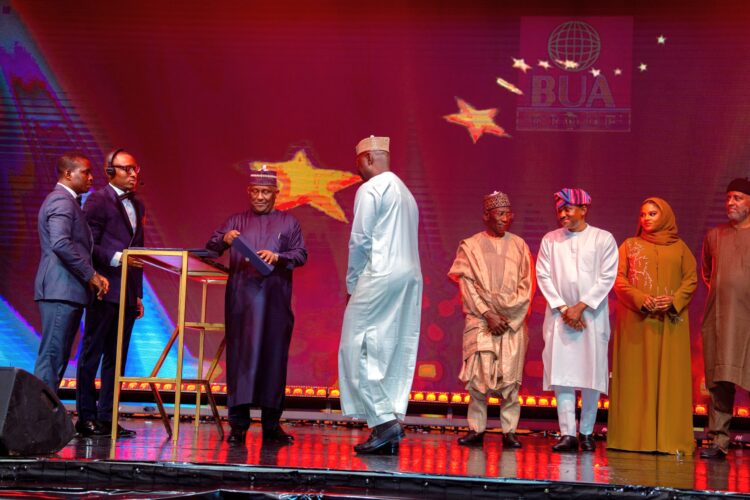
When Abdulsamad Rabiu rose to speak, applause followed him like a tide that already knew its destination. This was no routine corporate ceremony, but an accounting of time and loyalty translated into cash, honour, and public gratitude.
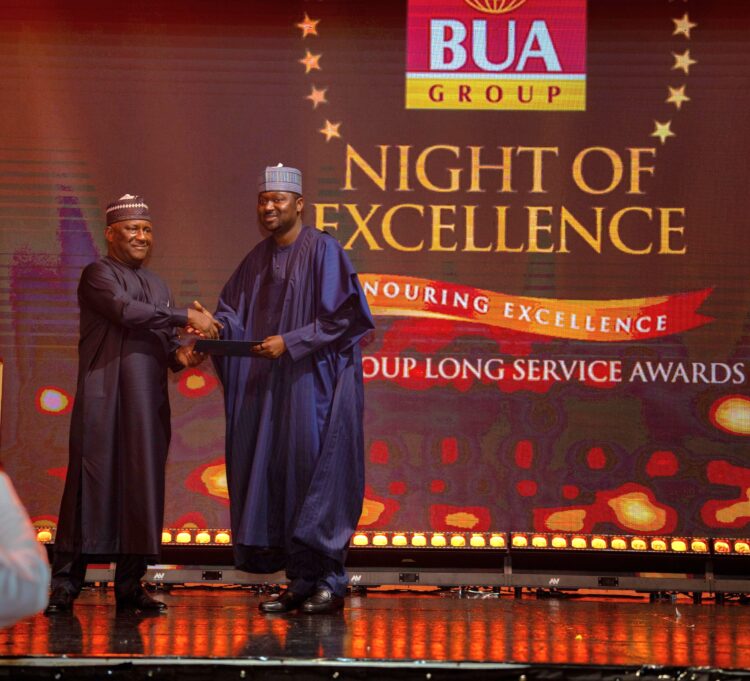
That evening, BUA Group committed N30 billion to 510 of its people to mark the 2025 Night of Excellence and Long Service Awards. The sum itself was startling, yet the deeper resonance lay elsewhere. This was capital kneeling briefly before labour, and a business empire confessing that its true word lived in human hands and human patience.
Rabiu’s voice resonated with the calm of a man addressing companions rather than subordinates. He recalled BUA’s gestation years: 36 years ago, the company commenced operations from humble beginnings, possessing neither glamour nor guarantees. The early structures stood vulnerable to Nigeria’s economic tempests, policy whiplash, infrastructural decay, and the dreadful sabotage of doubt. Factories rose slowly and markets tested his resolve. But through those years, BUA grew and its employees stayed.
Growth eventually arrived and BUA matured into one of Nigeria’s most valuable listed enterprises, its combined market capitalisation swelling into trillions. Its cement plants stretched across Nigeria’s geographical map, its sugar refineries hummed and food processing lines thickened. The company’s infrastructure footprints widened. Yet Rabiu refused to be seduced by the romance of solitary triumph. Capital alone, he reminded the room, never built endurance and strategy alone hardly survived Nigeria’s tumultuous business clime. People did.
According to Rabiu, every factory bears fingerprints invisible to the quarterly reports. Every solved crisis bore the quiet signature of technicians who refused shortcuts, managers who guarded standards, engineers who treated machines as living organisms, accountants who balanced risk with conscience, drivers who delivered through flooded roads, and security staff who kept vigil through restless nights. The awards night gathered these fragments into a single reckoning.
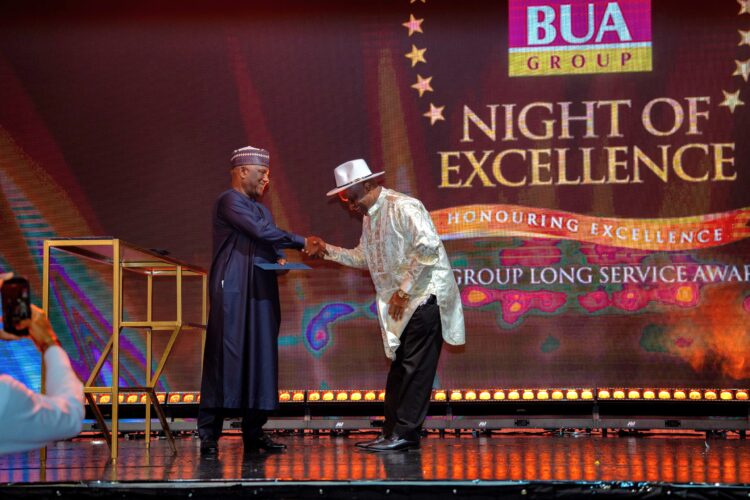
The Night of Excellence and Long Service Awards had become part of BUA’s cultural backbone, an annual ritual where loyalty ceased to be abstract. This edition, however, expanded the grammar of corporate gratitude in Nigeria. N30 billion moved from treasury to people. Five hundred and ten lives felt its weight and promise. Service periods stretched from five years into four decades, mapping a geography of commitment that predated many of Nigeria’s economic cycles.
Forty-one recipients stepped onto the stage, representatives of the highest categories. Their awards ranged from N100 million to N1 billion, sums that reframed retirement plans, children’s futures, medical anxieties, generational security. Sixteen received N100 million each. Nine took home N200 million each. Seven claimed N250 million each. Three stood for N500 million each. Five absorbed the astonishment of N1 billion each. Another recipient accepted a special award whose cash value remained unannounced, its symbolism eclipsing arithmetic.
Kabiru Rabiu’s recognition carried a particular gravity. Loyalty, leadership, and long service had bound him to the Group’s inner structure. The award acknowledged continuity, stewardship, and trust earned across seasons of expansion and strain. Applause followed him with the warmth reserved for figures whose influence runs deeper than title.
Others had already received their cheques and plaques quietly, away from cameras, across plants and operational locations scattered nationwide. The distribution itself mirrored the Group’s geography, affirming that value resided as firmly in distant factory towns as it did beneath chandeliers.
Rabiu called the awards tokens. The word carried humility. Money, he insisted, never measured decades of personal sacrifice, missed family moments, postponed dreams, or the courage required to stay when easier exits beckoned. Yet money spoke a language that could ease burdens, anchor dignity, and translate gratitude into tangible security. This evening allowed wealth to articulate respect.
The gesture unsettled familiar hierarchies. Nigerian corporate culture had long been haunted by stories of excess at the top and neglect below, of executive bonuses blooming amid layoffs, of labour treated as expendable line items. BUA’s decision ruptured that narrative. Here stood a founder who chose to redistribute celebration downward, anchoring success in shared prosperity.
Rabiu’s philosophy emerged without sermon. He spoke of partnership. Employees figured as co-owners of a journey, bearers of a legacy under construction. Loyalty and professionalism, he argued, demanded recognition expressed materially. Words alone grew thin without evidence. This conviction had shaped BUA from inception, embedding respect into policy, reward into culture.
The business logic beneath the generosity remained lucid, almost austere in its clarity. Enduring enterprises are not engineered solely by spreadsheets, algorithms, or the muscular confidence of capital; they are sustained by memory, by the quiet accumulation of trust, by continuity that refuses the seduction of shortcuts. Memory, in this sense, functions as an invisible archive of decisions made, mistakes survived, systems refined through lived experience rather than consultant slides. When a company honours that memory, it preserves the intelligence of its own becoming, ensuring that hard-earned wisdom does not evaporate with resignations or retirements.
Trust follows memory as its moral twin. Workers who feel recognised do not merely perform tasks; they assume guardianship. They protect systems instinctively, often without instruction, because those systems feel personal rather than imposed. Machinery is treated with care because it carries shared history. Processes are defended because they embody collective learning. In such environments, vigilance replaces surveillance, and responsibility becomes internal rather than enforced. This trust reduces friction, waste, and sabotage, creating an organisation that polices itself through shared ownership.
Continuity, then, emerges not as stagnation but as resilience. Institutional knowledge stays resident rather than fleeing because people no longer experience the enterprise as a temporary extraction point. They remain long enough to understand the reasons behind policies, the fragility of certain supply chains, the temperament of markets, the unwritten codes that govern crisis response. This knowledge, layered over time, forms a living infrastructure more valuable than any physical asset. Once lost, it cannot be repurchased at market rates; it must be grown patiently, person by person.
Values acquire permanence only when they outlive founders and current leadership. Companies that survive generational shifts do so because their ethical spine has been distributed widely, embedded in people rather than pinned to individuals. When staff are rewarded for loyalty and excellence, values cease to be aspirational slogans and become lived practices. They travel horizontally across departments and vertically across ranks, ensuring that leadership transitions do not trigger cultural amnesia. The organisation remembers itself even as faces change.
The N30 billion therefore functioned as a strategic instrument as much as a symbolic one. It anchored employees emotionally and materially to the future of the enterprise, reducing the volatility that accompanies uncertainty. Stability, in business terms, is not immobility; it is the confidence that allows intelligent risk-taking. When workers feel secure, they innovate without fear, flag problems early, and invest discretionary effort into outcomes rather than mere survival. Generosity, here, sharpened performance rather than dulling it.
This approach also corrected a long-standing distortion in corporate economics, where labour is treated as a cost to be minimised rather than an asset to be compounded. Assets appreciate when maintained, protected, and valued. By rewarding longevity and excellence, the company effectively recapitalised its human base, increasing the long-term yield of experience, loyalty, and institutional competence. The returns may never appear neatly on a balance sheet, yet they manifest in reduced turnover, stronger compliance culture, and operational coherence under pressure.
Ultimately, the gesture articulated a philosophy of stewardship rather than extraction. Wealth, when deployed with foresight, becomes a binding agent that holds people, principles, and purpose together. The investment spoke to an understanding that businesses collapse less often from market shocks than from internal erosion: cynicism, distrust, forgetfulness. By investing in its people at scale, the company fortified itself against that erosion, choosing endurance over spectacle, and continuity over convenience.
Listening that night, one sensed a deliberate refusal to separate heart from balance sheet. Empathy functioned here as strategy, gratitude as governance. Rabiu understood that Nigeria’s volatile terrain rewarded organisations whose people felt bound to them by honour rather than fear. The awards fortified that bond.
Stories circulated quietly across tables. A technician remembered nights spent coaxing a reluctant kiln through power fluctuations. A supervisor recalled managing payroll during currency freefalls. An administrator spoke of raising children on hope while factories matured. Their narratives braided into a collective biography of BUA, one authored over decades rather than press releases.
Rabiu traced the Group’s expansion plans with measured optimism. Capacity would grow. Advanced technologies would enter production lines. Cement, food, sugar, infrastructure would deepen their reach. The people who built the enterprise would grow alongside it. Progress would remain inclusive, anchored in continuity.
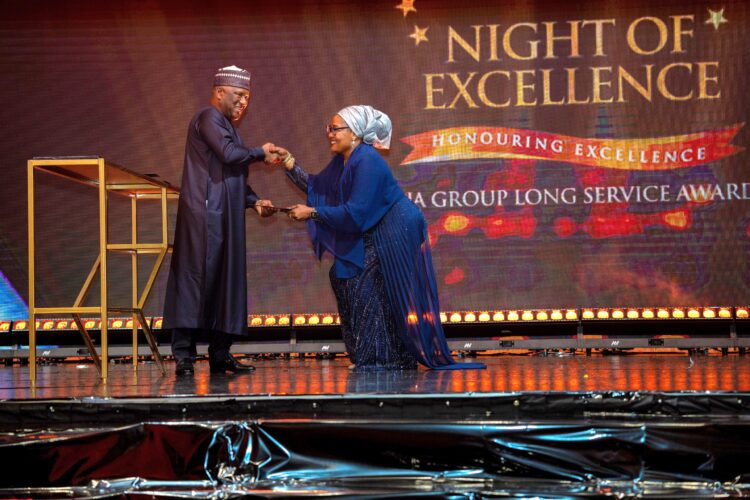
This assurance resonated. Nigerian workers had grown accustomed to watching companies outgrow them, leaving veterans stranded at the margins. BUA’s promise inverted that pattern, binding expansion to shared ascent.
The Night of Excellence thus became a moral document. It testified that capitalism, practiced with memory, could cultivate dignity. It suggested that African enterprise could resist extractive instincts inherited from colonial commerce. It hinted at a model where profit circulated within the community that produced it.
Rabiu himself embodied a restrained presence. His wealth rarely sought spectacle. His public interventions leaned toward infrastructure, industry, philanthropy, systemic repair. This awards night aligned seamlessly with that temperament. Generosity arrived without theatrical excess, yet its magnitude spoke loudly.
Observers within Nigeria’s business ecosystem took note. The sums redefined benchmarks. Conversations shifted. Questions followed. Could loyalty command such returns elsewhere? Could patience acquire value in an economy addicted to speed? Could founders learn to see staff as legacy rather than cost?
The answers lingered in the room, shimmering between applause and reflection. BUA had thrown down a quiet challenge.
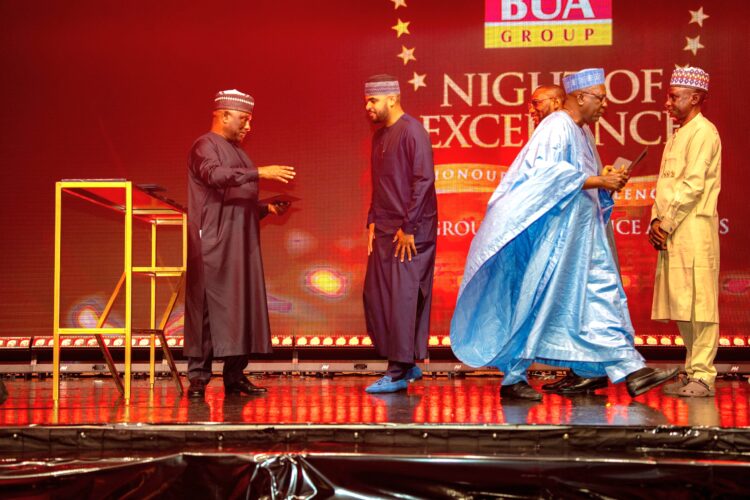
The aesthetic of the evening avoided ostentation. Elegance served purpose. Plaques gleamed modestly. Cheques carried transformative weight. Faces betrayed disbelief, gratitude, pride, relief. Some recipients wept openly, emotion bypassing decorum. Their tears narrated years compressed into a moment.
Journalistically, the scene resisted cynicism. Numbers aligned with sincerity. Policy matched rhetoric. There was little to interrogate beyond acknowledging rarity. In a country where labour often recedes into invisibility, BUA had illuminated it lavishly.
Rabiu’s recollection of the early years returned often to belief. Employees believed before results appeared. They stayed when margins thinned. They trusted a vision not yet vindicated by markets. This trust constituted invisible capital, compounding quietly until scale arrived. The N30 billion felt like interest finally paid on faith long deposited.
The awards also functioned as intergenerational instruction. Younger staff watched veterans honoured publicly, absorbing a lesson about patience and fidelity. Corporate culture transmitted itself through example rather than memo. Ambition learned to stretch across decades rather than quarters.
Across Nigeria’s manufacturing corridors, the ripple effects began. Workers discussed BUA differently. Loyalty regained narrative dignity. Employers felt scrutiny sharpen. The labour conversation shifted incrementally.
Rabiu’s insistence that no amount could fully compensate decades of service revealed an ethical ceiling to wealth. Money acknowledged contribution without claiming equivalence. Gratitude remained incomplete, appropriately so. This humility insulated the gesture from transactional cynicism.
The Night of Excellence closed with music, photographs, embraces. Yet its afterlife promised endurance. Cheques would fund education, healthcare, housing, entrepreneurship. Security would ripple through families. Gratitude would circulate quietly through communities.
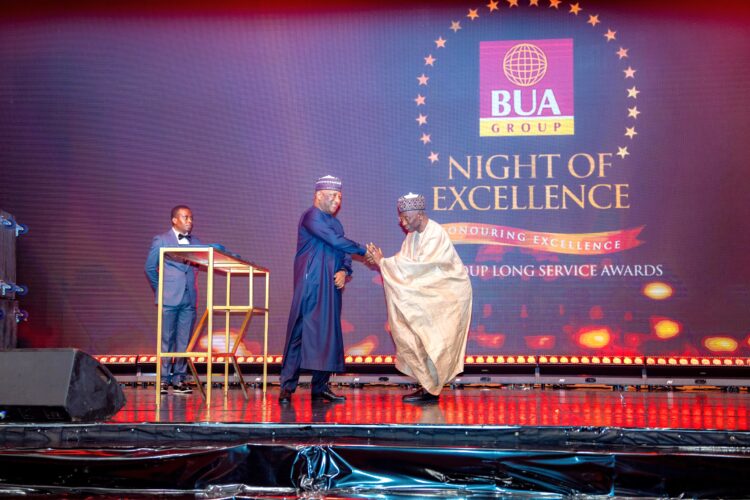
For Rabiu, the evening confirmed a philosophy long practiced. Businesses endure through people, empires crumble without memory, and wealth acquires greater substance only when it recognises the hands that built it.
In that hall, capitalism briefly slowed its breath, turned its gaze inward, and honoured its makers. The ledger balanced itself in human terms. Loyalty became fortune. Empathy found form. Abdulsamad Rabiu stood as witness and architect of a covenant rarely articulated so boldly in Nigerian commerce: success shared stays successful.
Such moments resist reduction to headlines, yet one insists. Where loyalty becomes fortune, an enterprise like Rabiu’s, rediscovers its soul.