


From Opebi To Ikoyi…His Climb From Low-key Security Gigs To Royal Supremacy
● The Super Attributes That Makes Him A Shoo-in For The Throne
Crowns seldom fall silent; they travel on the wings of consequence, choosing their bearers with a drama that unsettles dreams and expectations alike. Across Ijebuland, a charged stillness yields to astonishment as ancient rhythms of succession collide with a changing age. The old order watches as a new narrative unfurls, insistent and undeniable.
Such is the tremor now coursing through Ijebuland, where Abimbola Onabanjo, once a quiet operator in the shadows of Lagos commerce, is fast crushing the odds in his bid to emerge the new Awujale of Ijebuland, and so doing, succeed the late Oba Sikiru Adetona.
If Onabanjo succeeds, he would be leading both a new monarchy and a fresh narrative: the Ijebu Kingdom may yet pay homage to a 45-year-old whose journey from humble beginnings in Opebi to the polished opulence of Ikoyi; from arranging bouncers for crowded event halls to commanding the reverence of an ancient throne whose lineage stretches deep into Yoruba antiquity, is the stuff dreams are made of.
As traditional kingmakers betray greater preference for him, shock ripples through the Ijebu traditional circuits. Bookmakers, who had wagered heavily on older, more visibly entrenched contenders, are finding themselves outflanked by a candidate whose story defies the slow, predictable rhythms of royal succession. The preference for Onabanjo among kingmakers unsettles the old order and rewrites the script with bold, unapologetic ink.
Yet beneath his rise, lies something deeper: a recognition, perhaps reluctant, that the forces shaping modern leadership have long shifted. Influence now travels through unconventional routes. Power accrues in boardrooms as much as in ancestral compounds. Wealth, networks, and strategic proximity to the engines of governance carry a weight that tradition increasingly negotiates rather than resists.
Onabanjo embodies that convergence. Long before the polished marble floors of Ikoyi bore his imprint, before the gleam of a Rolls-Royce announced his arrival at elite gatherings, the 45-year-old lived a life defined by hustle, restraint, and modesty. Opebi, in Ikeja, served as the base of his earliest enterprise.

There, he carved a niche that many dismissed as mundane: coordinating bouncers and security personnel for events. Weddings, corporate gatherings, nightlife venues, and spaces where order was essential yet rarely glamorous. It was a business built on reliability, discretion, and trust. Onabanjo learned early that presence could be power, and that control often lay in the unseen hands managing the periphery.
Those who encountered him in those years recall a man of measured speech and relentless focus. He neither advertised ambition loudly nor cloaked it in false modesty. He worked. He observed. He refined.
Opportunity, when it arrived, did not announce itself as a miracle. It appeared as access—first through the administration of former Lagos State governor Akinwumi Ambode. A door opened, and Onabanjo stepped through with the precision of one who understood that proximity to power demanded both loyalty and competence.
From that point, ascent gathered momentum. Governor Babajide Sanwo-Olu became a defining axis in Onabanjo’s trajectory. Their relationship, described by insiders as close and mutually reinforcing, positioned him within a network where influence translates into opportunity and opportunity into expansion.
Through this alignment, Onabanjo’s fortunes expanded rapidly. His ventures diversified, his visibility increased, and his name began to circulate within elite circles as a businessman whose reach extended into the delicate intersections of governance and enterprise.
Then he moved to Ikoyi; this was a symbolic shift as much as a geographical one. Onabanjo switched from a life of modesty to one of intimidating luxury. The man who arranged bouncers and security for parties became the proud owner of the finest, most impressive automobiles: Rolls-Royce, Range Rover, and an array of high-end possessions became part of his new lifestyle.
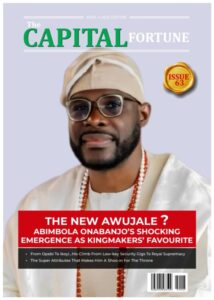
Yet even within that environment, Onabanjo cultivated a persona that blends affluence with strategic reserve. He attends, observes, engages, but rarely overexposes. Through his evolution, his wife, Tolu, stood beside him like a figure of grace and accomplishment. Her professional success at Craneburg reinforces the image of a household anchored not only in wealth but in competence and industry. Together, they represent a modern aristocracy forged through enterprise rather than inherited privilege.
Recent days offered a telling glimpse into Onabanjo’s expanding orbit. A meeting with President Bola Tinubu—captured in a photograph that has since circulated widely—places him firmly within the inner corridors of national influence.
The image speaks volumes: two men, each emblematic of different arcs of Nigerian power, standing side by side. One, a seasoned political titan; the other, a rising figure whose journey from obscurity to prominence encapsulates the fluidity of contemporary elite formation.
For observers, the photograph serves as both confirmation and prophecy. It confirms Onabanjo’s access. It suggests a future in which his role may extend into traditional authority and beyond broader spheres of influence.
Still, the story of the kingmakers’ fascination with him as the preferred Awujale, resists reduction to mere connections or wealth. It is also a story of disruption; of a system confronted and gradually being won over by a candidate who does not fit its most familiar molds.
Ijebu’s royal institution carries with it a weight of expectation, a reverence for continuity that often favors candidates whose lineage and seniority align neatly with established norms. Onabanjo’s candidacy challenges those expectations.
Younger, wealthier, and moulded outside the traditional pathways that usually define royal grooming, Onabanjo’s candidacy forces a reckoning within the institution itself. What defines readiness for kingship in an era where economic power and global exposure shape leadership as profoundly as lineage?
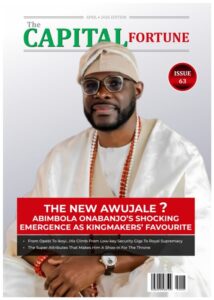
For some, Onabanjo’s eventual emergence as the new Awujale would signal a departure from orthodoxy. For others, it would represent adaptation, a recognition that tradition survives not by rigidity but by its ability to absorb and reinterpret change.
Those who have followed Onabanjo’s business journey point to a pattern that offers insight into his appeal. He builds, methodically and patiently. With an eye for gaps others overlook.
From the early days of event security coordination, his ventures evolved into more structured enterprises. Extol Security Services grew into a respected entity, serving clients across sectors with an emphasis on reliability and professionalism. Trust became currency, and he accumulated it steadily.
KMF Oil & Gas Limited expanded his footprint into the energy sector, navigating a complex terrain where regulatory challenges often deter less resilient operators. Scent Arcade Limited introduced a touch of luxury into hospitality spaces, reflecting an instinct for diversification. Kleensteps Limited, his more recent venture, continues that trajectory of identifying needs and meeting them with structured solutions.
A common thread runs across these enterprises: execution. Projects initiated are seen through. Systems are built to endure and relationships are maintained with a consistency that fosters long-term trust.
Such qualities resonate beyond commerce. They speak to governance, leadership, and the capacity to manage complexity without succumbing to it.
His tenure as Senior Special Assistant on Special Duties to the Governor of Lagos State further honed these attributes. Within the machinery of government, Onabanjo cultivated a reputation for diligence and follow-through.
Colleagues recall a figure who approached assignments with analytical clarity, grounding recommendations in data and ensuring that initiatives moved from conception to completion. It is a reputation that now shadows his bid for the throne, promising, perhaps, a reign shaped by similar discipline.
Yet, amid the narratives of wealth, influence, and competence, the most compelling aspect of Onabanjo’s story remains its origin. Opebi.
That beginning carries symbolic weight. It anchors his story in a reality that many Nigerians recognise intimately: the struggle to build from limited means, the necessity of ingenuity, and the quiet persistence required to transform small opportunities into larger platforms.
His journey offers a counterpoint to the notion that leadership must emerge from inherited advantage. It suggests that experience forged through everyday enterprise can produce a form of wisdom uniquely suited to contemporary challenges.
For the youth of Ijebuland, Onabanjo’s eventual ascension to the throne may resonate as a reminder that pathways to influence are no longer confined to traditional routes alone.
Still, reverence for tradition remains central to the throne he currently jostles for. The Awujale is not merely a figurehead; he is a custodian of culture, a symbol of continuity, a bridge between past and future.
If Onabanjo wins, he’d be stepping into that role with a lineage that connects him to the Awujale Fasengbuwa through Omoba Osinuga, Omoba Osiyoku, and Omoba Laminu Abimbola Aderibigbe. Heritage grounds him, even as modernity shapes him.
This duality may prove to be his greatest asset. If selected as the new Awujale, as insiders suggest, he’d be that monarch who understands both the sanctity of tradition and the demands of a rapidly evolving society. A leader capable of speaking the language of elders while engaging the aspirations of youth; a custodian who recognises that preservation and progress need not exist in opposition.
Reactions across Ijebuland reflect a spectrum of emotion over the possibility of Onabanjo’s emergence as the new paramount monarch. Excitement mingles with skepticism even as admiration intersects with caution. Questions linger about what his reign will signify in practice. Will his business acumen translate into effective traditional leadership? Can the instincts honed in commerce adapt to the nuanced demands of cultural stewardship? How will he navigate the expectations of a people deeply rooted in history yet increasingly influenced by modern realities?
These questions linger in the air, awaiting answers that only time can provide. For now, what stands undeniable is the magnitude and promise of his candidacy.
A man who once coordinated security at events has quietly emerged kingmakers’ favourite for a throne that commands reverence across Nigeria. A figure shaped by the rhythms of Lagos commerce may most likely emerge the spiritual and cultural authority of Ijebuland.
His story disrupts linear narratives and introduces complexity into the idea of kingship, inviting a reconsideration of how power may be acquired and legitimised.
Abimbola Onabanjo, moulded from the dust of humble beginnings and refined by the polish of extraordinary success, may yet bear the weight of a crown that demands both reverence and vision.