

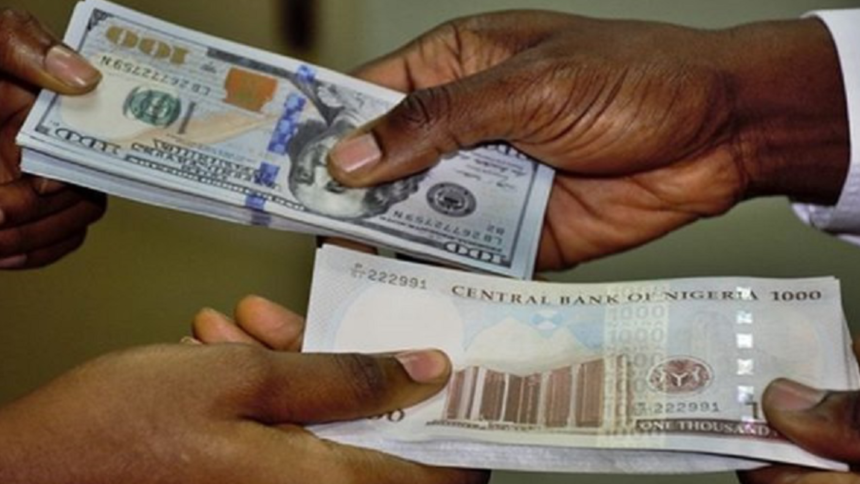
The Naira continued its decline against the United States Dollar at N1,378.02/$1 at the Nigerian Foreign Exchange Market (NAFEM).
The new exchange represents a N14.63 or 1.07% depreciation when compared to last Friday’s N1,363.39/$1, according to Legit.
New naira exchange rate against other currencies
The Nigerian currency also weakened against other major currencies, trading at N1,846.14/£1 versus N1,836.49/£1 for the British Pound and N1,612.98/€1 against the Euro, down from N1,609.22/€1 in the previous session.
In the parallel or black market, the Naira also slipped, reflecting growing demand pressures.
Abudullahi, a BDC trader, said: “We bought the dollar at N1,374 per $1 and sold it at N1,395 per $1, the pound at N1,840 per £1 and sold it at N1,875 per £1, and the euro at N1,590 per €1 and sold it at N1,625 per €1.”
CBN boost dollar supply
The Central Bank of Nigeria (CBN) intervened by selling $200 million to boost supply, part of its broader February operations, which saw it sell $225 million and purchase $261.8 million, BusinessDay reports.
Despite these measures, market pressures continued as demand for dollars exceeded available supply.
Coronation Merchant Bank’s research arm reported that total foreign exchange inflows into the official window rose to $1.07 billion last week, up from $648.2 million the previous week, signalling improved liquidity.
Analysts, however, maintain that the exchange rate remains within its projected N1,350 to N1,450 per Dollar band, cautioning against panic.
Analysts say the combination of geopolitical tension and rising oil prices has strengthened the dollar’s appeal.
The rally reflects renewed demand for dollar-denominated assets amid escalating risks in the Middle East.
Muda Yusuf on dollar movement
Muda Yusuf, Chief Executive Officer Centre for the Promotion of Private Enterprise (CPPE) have reacted to the ongoing conflict between the US, Israel and Iran.
He said: “The naira could strengthen from higher oil export earnings, which would boost reserves and improve FX market liquidity, but geopolitical instability and capital outflows could offset these gains, leaving the net impact on the currency uncertain.”