
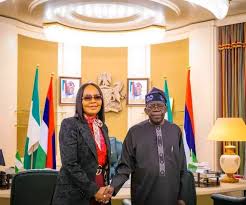
Nkiruka Onyejeocha has resigned her appointment as Minister of State for Labour and Employment, commenced a calculated political return to Abia State, where she’s eyeing the All Progressives Congress (APC) ticket for the Isuikwuato/Umunneochi Federal Constituency, a seat she held for 16 years before joining the federal cabinet.
The former lawmaker’s exit followed the presidential directive requiring political appointees seeking elective offices to step down ahead of the election cycle.
Party insiders say the move wasn’t merely procedural but strategic, giving the former lawmaker sufficient time to rebuild grassroots structures and re-engage constituents ahead of the 2027 contest.
Onyejeocha represented the constituency in the House of Representatives from 2007 to 2023, making her one of the longest-serving federal lawmakers from Abia State.
During her legislative career, she chaired key committees, including Aviation, and was widely recognised for constituency-focused interventions spanning rural electrification, school rehabilitation, youth empowerment programmes and road projects that helped entrench strong voter loyalty across communities.
Political analysts believe this incumbency advantage significantly strengthens her comeback prospects. Unlike many returning aspirants, Onyejeocha retains an established political machinery built over four electoral victories, deep ward-level networks and enduring name recognition among constituents.
Her ministerial tenure is also viewed as an added political asset. As Minister of State for Labour and Employment, she played roles in labour negotiations, employment policy coordination and federal workforce initiatives, elevating her national profile while strengthening ties within the APC leadership hierarchy. Allies argue that cabinet exposure expanded her political reach beyond Abia, improving her leverage during party primaries where delegate alignment often proves decisive.
Within APC circles, she’s regarded as a stabilising figure capable of consolidating the party’s presence in Abia’s evolving political landscape. Her early compliance with the resignation directive is said to have earned goodwill among party leaders, reinforcing perceptions of loyalty and discipline, qualities that carry significant weight in internal party calculations.
Observers also note the absence of a deeply entrenched incumbent political structure in the constituency, creating an opening for a familiar and experienced candidate with proven electoral appeal.
While emerging opposition dynamics may test her mobilisation strength, supporters maintain that Onyejeocha’s blend of legislative experience, ministerial exposure and entrenched grassroots networks places her in a strong position to reclaim the House of Representatives seat in 2027, potentially staging a swift political comeback under the APC platform.