

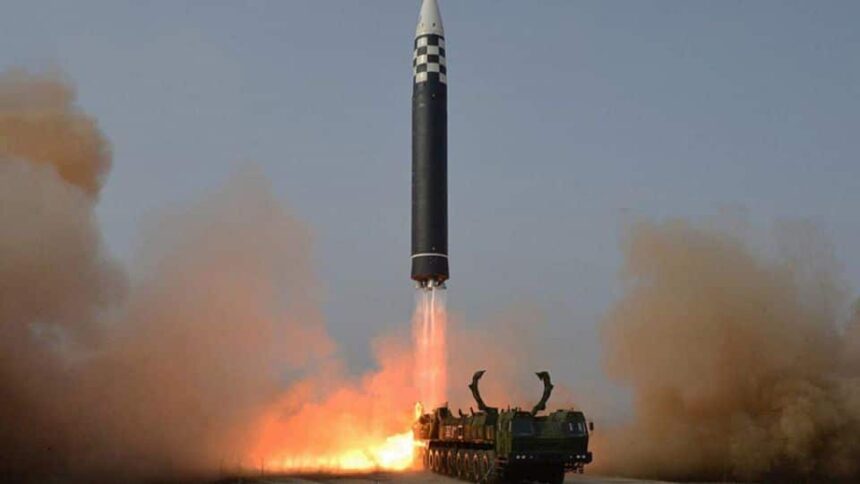
North Korea launched a barrage of roughly 10 ballistic missiles toward the eastern sea on Saturday, according to South Korea’s military, marking a pointed display of force amid joint drills by Seoul and Washington.
South Korea’s Joint Chiefs of Staff said the projectiles were fired from the Sunan area near Pyongyang’s international airport and traveled about 350 kilometers before landing at sea.
Japanese authorities confirmed the weapons fell outside Japan’s exclusive economic zone and reported no damage to aircraft or vessels, AP reported.
The missile activity unfolded as South Korean and United States forces pressed ahead with their annual spring exercises involving thousands of troops.
Seoul’s military said it has intensified surveillance and remains on heightened readiness while sharing real time intelligence with Washington and Tokyo. The drills have drawn renewed scrutiny as Washington is also engaged in a widening conflict in the Middle East.
Local media in Seoul have speculated that some U.S. missile defense assets stationed in South Korea could be repositioned to support operations elsewhere. Those reports have fueled public concern about possible gaps in the country’s defenses.
South Korea’s presidential office declined to confirm details about U.S. military movements. Officials said any redeployment would not weaken the allies’ posture against a nuclear armed North Korea and pointed to Seoul’s conventional military capabilities.
The launches came only hours after South Korean Prime Minister Kim Min-seok met U.S. President Donald Trump in Washington, where he voiced hope for renewed diplomacy with Pyongyang.
President Lee Jae Myung has sought to ease tensions with the North, and aides have suggested that Trump’s upcoming visit to China could open diplomatic space.
Saturday’s missile test appeared to counter that optimism. Pyongyang has hardened its stance toward Seoul in recent months and has urged Washington to abandon denuclearization demands before talks can resume.
North Korea routinely condemns allied drills as invasion rehearsals and often answers them with weapons demonstrations. In previous years, the North has staged salvo launches framed as simulations of nuclear strikes on South Korean targets.

