
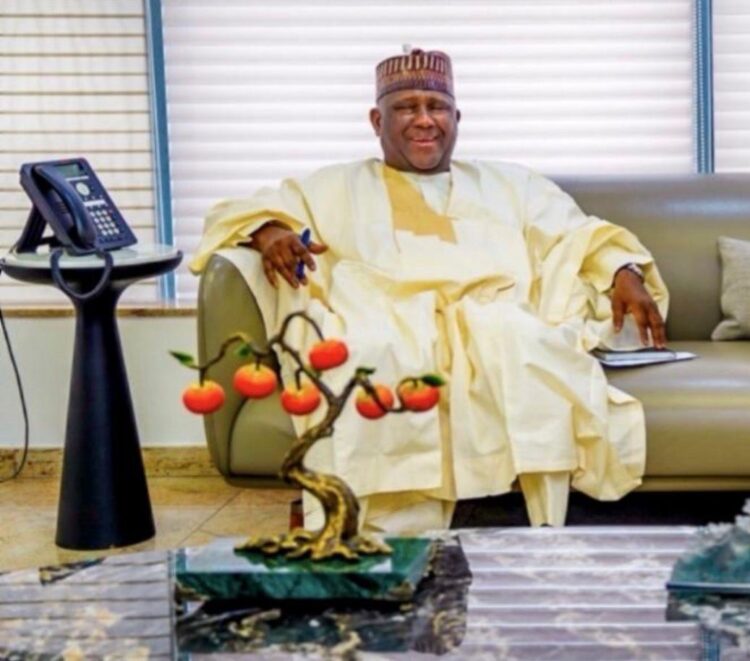
● Nigeria hails its industrial titan as markets crown his defining ascent
● Admiration trails $15.8bn milestone: Industrialist’s ascent to second richest African triggers continental talking point
The recognition of wealth often bears a solitary aura, an image of individual triumph cast in the glow of personal achievement. Abdulsamad Rabiu’s ascent has disrupted that familiar framing.
The celebration of his ascent to the position of second richest African has taken on a communal texture: voices from Nigeria’s financial corridors have embraced the moment as a national milestone, even as analysts speak of validation, a signal that indigenous enterprise continues to shape the trajectory of African capitalism.
Industrialists, on their part, reference the ascent with a tone that blends admiration with renewed ambition. Young entrepreneurs read the news with renewed focus, drawing inspiration from Rabiu’s climb.
Across Lagos, Abuja, Kano, and far beyond, the narrative unfolds with a sense of shared ownership. A familiar ritual plays out each year across global business media: billionaire rankings arrive with an air of ceremony, offering a snapshot of wealth at its most rarefied level. For many observers, those lists carry a faintly theatrical quality: names rise and fall, fortunes expand or contract, and the numbers often feel detached from the lived realities of everyday economies.
Yet, every so often, a shift occurs that compels even the most sceptical watchers to pause and pay attention. Abdulsamad Rabiu’s recent ascent to become Africa’s second richest man is one of those moments.
What makes this development particularly striking is not simply the scale of Rabiu’s fortune, now estimated at $15.8 billion, but the speed with which he has climbed. Barely three weeks ago, he occupied the third position on the continent’s rich list. Today, he has overtaken long-established rivals to sit just behind Aliko Dangote, Africa’s richest man. The movement has been swift, almost abrupt, yet it has not come as a complete surprise to those who have been tracking the performance of his business empire over the past year.
Across Nigeria’s financial and political circles, Rabiu’s rise has been greeted with a mixture of admiration, curiosity, and, in some quarters, quiet pride. In Lagos boardrooms, where conversations often revolve around market signals and corporate performance, his ascent has been interpreted as validation of a broader shift toward industrial-scale enterprise.
In Abuja, policy watchers see it as evidence that local capital, when strategically deployed, can achieve continental relevance. In Kano, where Rabiu’s story began, the mood carries a more personal resonance, reflecting the journey of a son of the soil whose influence now stretches far beyond regional boundaries.
The reaction has not been confined to Nigeria alone. Across Africa, Rabiu’s elevation to second place has sparked renewed interest in the composition of the continent’s billionaire class. For years, the upper tiers of that list have been dominated by a relatively stable group of figures, including South Africa’s Johann Rupert and Nathie Kirsh, as well as Egypt’s Sawiris family and Nigeria’s own Mike Adenuga. Rabiu’s rapid climb has disrupted that equilibrium, introducing a new dynamic into a hierarchy that once seemed largely settled.
To understand how this shift occurred, it is necessary to look beyond the headline figures and examine the underlying drivers of Rabiu’s wealth. At the centre of his fortune lies BUA Group, a conglomerate with significant interests in cement production, sugar refining, flour milling, and infrastructure development. These are sectors that rarely attract the kind of glamour associated with technology or finance, yet they form the backbone of any functioning economy. Cement underpins construction, sugar and flour sustain food supply chains, and infrastructure connects markets, enabling trade and growth.
Over the past year, BUA Cement, widely regarded as the flagship of Rabiu’s industrial empire, has delivered exceptional performance. Its share price has surged, reflecting both strong fundamentals and favourable market conditions. Nigeria’s equity market has experienced a period of renewed momentum, driven in part by regulatory changes that have encouraged greater institutional investment, particularly from pension funds. This influx of capital has lifted valuations across several sectors, but BUA Cement has emerged as one of the standout beneficiaries.
Investors, it seems, have begun to recognise the scale and coherence of Rabiu’s strategy. What was once seen as a collection of industrial assets is now increasingly viewed as an integrated system, capable of generating sustained value across multiple segments of the economy. This shift in perception has translated into tangible gains in market capitalisation, which, in turn, have significantly boosted Rabiu’s personal net worth.
The numbers tell a compelling story of acceleration. At the start of the year, Rabiu’s fortune stood at approximately $10.4 billion, placing him fifth among Africa’s richest individuals. By February, that figure had risen to $11.3 billion, accompanied by a year-to-date gain of $1.21 billion. March brought a more dramatic leap, with his net worth reaching $14.6 billion and his ranking improving to fourth on the continent. Within weeks, he had climbed back into third place with a fortune of $15.9 billion, overtaking competitors and reasserting his position among the continent’s elite.
Now, with a slightly adjusted valuation of $15.8 billion, Rabiu has secured the second position, surpassing Rupert and extending his lead over Kirsh and Adenuga. The speed of this progression is unusual in the world of billionaires, where fortunes typically evolve gradually rather than in sudden bursts. It suggests a convergence of favourable factors, including strong corporate performance, supportive market conditions, and well-timed strategic decisions.
Despite the attention that his rising wealth has attracted, Rabiu himself is widely regarded as a relatively understated figure. Those who have worked closely with him often describe a businessman who prefers to focus on operational details rather than public recognition. Discussions tend to centre on production capacity, logistics, and long-term planning, rather than the spectacle of rankings or the trappings of wealth. This disposition stands in contrast to a global environment in which many high-profile entrepreneurs actively cultivate public personas.

Yet, even a reserved approach cannot shield him from the spotlight entirely. At a net worth approaching $16 billion, visibility becomes almost inevitable. Media coverage intensifies, analysts dissect each movement in the rankings, and public interest grows. In Rabiu’s case, this attention has been accompanied by a largely positive reception, reflecting both respect for his achievements and recognition of the broader implications of his rise.
One of the most significant aspects of Rabiu’s ascent lies in its impact on Nigeria’s internal hierarchy of wealth. For many years, the ranking of the country’s richest individuals followed a relatively predictable pattern, with Dangote at the top, followed by Adenuga, whose telecommunications and oil investments secured his position as a perennial contender. Rabiu’s emergence as the clear number two has altered that dynamic, creating a new configuration that reflects changing realities within Nigeria’s business landscape.
The gap between Rabiu and Adenuga is particularly notable. With a fortune of $15.8 billion compared to Adenuga’s $6.5 billion, the difference is substantial and has grown rapidly over a relatively short period. This shift has prompted discussions about the evolving nature of wealth creation in Nigeria, with greater emphasis now being placed on industrial and manufacturing activities as drivers of large-scale value.
Beyond the realm of personal wealth, Rabiu’s influence extends into philanthropy and social development. Through the Abdul Samad Rabiu Africa Initiative, he has committed significant resources to projects in education, healthcare, and community development. Universities across Nigeria have received funding for infrastructure improvements, including lecture halls, laboratories, and student facilities. Hospitals have benefited from targeted interventions aimed at enhancing medical capacity and improving patient outcomes.
These efforts have contributed to a public image that combines business success with a sense of social responsibility. In many ways, this dual role reinforces the perception of Rabiu as a figure whose impact reaches beyond corporate balance sheets, touching on broader questions of development and national progress.
Within the wider African context, Rabiu’s rise carries symbolic weight. It highlights the potential for locally rooted enterprises to achieve continental prominence, challenging narratives that often emphasise external investment or resource-based wealth. By building his fortune through industries that are fundamental to economic development, Rabiu has demonstrated the viability of a model grounded in production and infrastructure.
At the same time, his ascent underscores the fluid nature of wealth rankings. Positions that once appeared stable can change rapidly, influenced by market fluctuations, strategic decisions, and external economic conditions. Rupert’s recent decline in net worth, for example, created an opening that Rabiu was able to exploit, while Kirsh’s earlier gains proved insufficient to maintain his standing in the face of Rabiu’s surge.
At the very top of the hierarchy, Dangote’s position remains secure, with a fortune of $33.6 billion that places him well ahead of his closest competitors. The distance between first and second is considerable, reflecting the scale of Dangote’s industrial empire. Nevertheless, the emergence of Rabiu as a strong number two adds a new dimension to the continent’s wealth landscape, suggesting a gradual diversification of economic power.
For observers of African business, Rabiu’s ascent offers several points of reflection. It illustrates the importance of strategic focus, particularly in sectors that underpin economic activity. It highlights the role of capital markets in amplifying the value of well-structured enterprises. And it demonstrates how sustained investment over time can yield significant returns when aligned with favourable conditions.
Perhaps most importantly, it provides a narrative that resonates beyond the confines of wealth rankings. In a region often characterised by economic challenges, stories of large-scale success carry a certain symbolic value. They serve as reminders of what is possible, offering a counterpoint to more pessimistic narratives and reinforcing a sense of potential.
As celebrations continue across various quarters, it is worth noting that Rabiu’s journey is far from complete. Wealth rankings, by their nature, capture a moment in time rather than a final outcome. Future shifts in market conditions, corporate performance, or strategic direction could alter the current configuration. For now, however, the significance of his achievement remains clear.
Abdulsamad Rabiu stands as Africa’s second richest man, a position earned through a combination of industrial acumen, strategic timing, and favourable market dynamics. His rise has reshaped the continent’s billionaire hierarchy and sparked conversations that extend far beyond the numbers themselves.
For Nigeria, the moment carries a particular resonance. It reflects the growing capacity of local enterprise to operate at scale, compete at a continental level, and command global attention. For Africa, it signals an evolving landscape in which new actors can emerge and redefine the contours of wealth and influence.
And for Rabiu himself, it marks another chapter in a story that continues to unfold, one shaped by the disciplined execution of strategy and the enduring pursuit of growth within the real economy.