

● New aircraft elevates BUA’s horizon, deepens billionaire’s reach across continents
● An empire built on cement, ports, power, ascends into a new chapter of speed and strategic grace
A fresh star glows above the hemispheres of enterprise as Abdul Samad Rabiu welcomes a Bombardier Global 8000 into his fleet, a winged testament to the clarity, scale, and audacity of his vision. The aircraft glimmers like a silver stanza carved across the sky, joining the Challenger 350 and Global 6500 as the newest envoy of a man whose life continues to read like an atlas of African possibilities.
Its arrival enriches the vast corridors Rabiu now commands from Lagos to Dubai, from Port Harcourt to Houston, from Sokoto to the edges of Europe’s commercial capitals. The jet manifests speed and strategy in its trail, a rare fusion of engineering brilliance and business foresight.
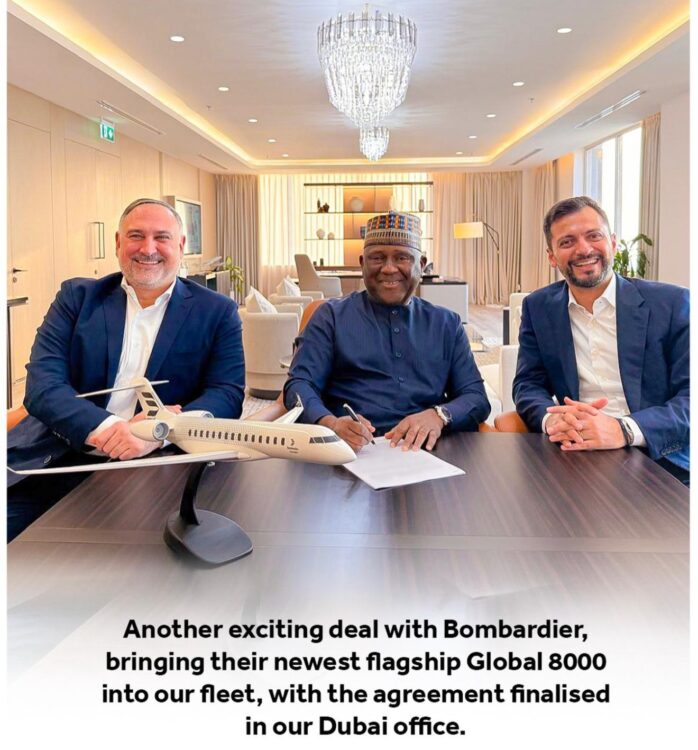
This epic attainment dawned on Thursday, December 4, 2025. Rabiu, seated with a quiet certainty honed by decades of enterprise, affixed his name to the purchase agreement beside Bombardier executives in BUA’s Dubai office.
The moment marked an ascension shaped by the logic of a man who has learned to live inside the arc of long distances—industrial, continental, and now, atmospheric. The Global 8000 will not merely move him across oceans; it will ferry the future across his expanding dominions.
The Global 8000 stands crafted for distances that once felt unreachable from African boardrooms. Lagos to New York unfolds beneath its wings without pause. Dubai to Houston stretches like a ribbon of sky easily claimed. The aircraft’s ultra-long-range capability fits Rabiu like a well-measured garment, tailored for the cross-continental undertakings shaping BUA’s evolving geography. The jet rests poised to serve as a strategic artery for a businessman whose operations breathe across Africa, the Middle East, and Europe.
Cement plants hum across Sokoto and Edo. Port terminals throb along the volatile veins of Nigeria’s maritime trade. Flour mills, sugar refineries, energy systems, and industrial hubs stretch across Rabiu’s map like galaxies that keeps widening. The aircraft becomes an inevitable extension of that momentum, the kind of machine summoned by the sheer volume and pace of responsibilities he carries. It becomes a winged calendar, trimming hours, tightening connections, expanding the margins of possibility around every meeting, negotiation, partnership, and inspection he must oversee.
Yet beneath its mechanical might, the aircraft glows with symbolism. It speaks of Africa’s refashioning, of the rise of indigenous capitalists who no longer wait for the world to validate their leap.
Its purchase expands Rabiu’s fleet into one of the most modern corporate aviation lineups owned by a Nigerian company, a statement of confidence, preparation, and forward rhythm.
Rabiu’s ambitions never hover in abstraction. They land on soil, steel, and stone. They burrow into infrastructure and lift entire sectors with the force of long-term commitment. The past two years reveal a man engineering growth like a sculptor chipping through time.
Terminal B at the Rivers Port Complex in Port Harcourt now rests under the sway of BUA’s reconstruction effort, a $65 million injection carved fully from the group’s capital. The project burns with Rabiu’s philosophy: build without waiting for applause; build where the nation bleeds; build with a horizon wider than quarterly earnings. The transformation of Terminal B positions BUA as a formidable force in Nigeria’s maritime architecture, a long-term player rewiring a strategic gateway that influences trade from the Niger Delta to West Africa’s coastal economies.
This port renaissance mirrors the logic behind the Global 8000: scale, speed, and structural advantage. Just as the port seeks to streamline maritime flow, the aircraft promises precision across Rabiu’s transcontinental engagements. Both investments illuminate a leader who builds systems around his vision, ensuring that infrastructure, mobility, and timing bend toward his industrial choreography.
The Global 8000 takes flight alongside another towering venture: the integrated refinery project rising in Akwa Ibom. The project moves toward its commissioning timeline, preparing to add fuel security, industrial vigor, and economic uplift to the nation. A dedicated gas-fired power plant stands beside it, an assurance that the refinery’s pulse will not suffer the erratic rhythms that define Nigeria’s power landscape.
This cluster of infrastructure mirrors Rabiu’s blueprint for the future: tightly integrated systems, each enhancing the efficiency of the other. Refineries, ports, terminals, power plants, and cement factories begin to resemble chapters of a single, coherent book. Their interdependence creates a vast industrial ecosystem capable of shaping markets and stabilizing supply chains.
The aircraft becomes a loyal companion to this blueprint. Its range and reliability provide Rabiu with the capacity to move between these industrial theatres—Lagos, Port Harcourt, Uyo, Dubai, Europe—without losing time or strategic footing. Its engines echo the hum of turbines in Akwa Ibom. Its cabin reflects the calm necessary for decisions that mold economies. Its flight path traces the outlines of an empire evolving with disciplined elegance.
Cement remains the bedrock of Rabiu’s ascent. BUA Cement continues to expand operations in Sokoto and Edo, its kilns firing through the nights as demand deepens. Revenue curves rise with unforced confidence. Profit lines sharpen with disciplined management. The company’s growth mirrors Rabiu’s philosophy of accessibility—cement must remain within reach of the ordinary builder, the small contractor, the young family laying foundations for their future.
His decision to champion lower cement prices shook the market with a moral clarity that unsettled some and uplifted many. It was an intervention aligned with his ethos: wealth must translate to utility; influence must serve collective advancement. The aircraft’s purchase, therefore, loops back to the same central truth, Rabiu’s growing reach always circles back to national benefit. A man who invests in ports, refineries, terminals, energy grids, and lower building costs does not acquire an aircraft for indulgence; he acquires it to match the scale of his commitments.
The Global 8000 becomes a tool for discipline, not distraction. It is a moving boardroom and a mobile command centre for engagements that facilitate jobs, growth, and infrastructure across Nigeria and beyond.
Rabiu’s ventures draw strength from their financial backbone. A $200 million corporate finance facility, arranged through the Africa Finance Corporation and Afreximbank, reinforces BUA’s balance sheet, widening the runway for new projects. This infusion of capital arrives as a validation of BUA’s integrity, governance structure, and long-range stability. Global institutions place their weight behind Rabiu’s expansions, echoing his credibility through the corridors of international finance.
The Global 8000 enters this landscape as a symbol of readiness. Every major project now sits undergirded by both financial and operational capacity. The aircraft ensures that distance, geography, and time will not delay momentum. It guarantees immediacy across continents, supporting the execution tempo necessary for an industrialist managing a constellation of billion-dollar undertakings.
Its purchase announces the beginning of a new chapter where BUA moves with greater speed, deeper insight, and wider scope. It marks Rabiu’s transition from continental player to global operator, from industry leader to architectural presence in international markets.
The story of this aircraft, however, folds into the story of the man who commands it. Rabiu continues to embody the quiet dignity of a leader who speaks rarely but builds constantly. His empire rises without noise. His influence expands without spectacle. His moves bear the calm of a man who reasons in decades rather than quarters, continents rather than regions.
The Global 8000 reflects that personality—quiet on the outside, astonishing beneath the surface. It becomes an extension of Rabiu’s temperament: focused, deliberate, refined. Its long-range capability mirrors his long-term worldview. Its engineering precision mirrors his managerial discipline. Its atmosphere of calm mirrors his understated confidence.
Yet above all, the aircraft reflects the life of a man who carries Africa’s economic hopes across his shoulders without faltering. His investments stretch from the ground to the sky, from factories to refineries, from terminals to trade routes. His dreams expand across the spheres of industry, philanthropy, national development, and global influence.
The acquisition of the Global 8000 rises beyond corporate aviation. It marks Rabiu’s next orbit, signalling readiness for broader alliances, deeper markets, and new industrial terrains. It affirms BUA’s position as a continental force preparing for the next decade of infrastructural disruption and economic transformation.
The aircraft ascends into Rabiu’s fleet like a verse into an unfinished epic. It strengthens the rhythm of a story still unfolding across ports, factories, refineries, energy platforms, and philanthropic undertakings. It hints at futures yet unshaped, continents yet traversed, partnerships yet forged.
A new chapter takes flight and a new altitude emerges for a man whose life has become a compass for Africa’s advance. Abdul Samad Rabiu stands at 65 as both visionary and builder.
The Global 8000 becomes the latest stanza in his skyward song, a vessel carrying the weight of his vision into the boundless vaults above.