● Forbes crowns BUA chairman Africa’s third richest man as his fortune rockets to $11.2bn
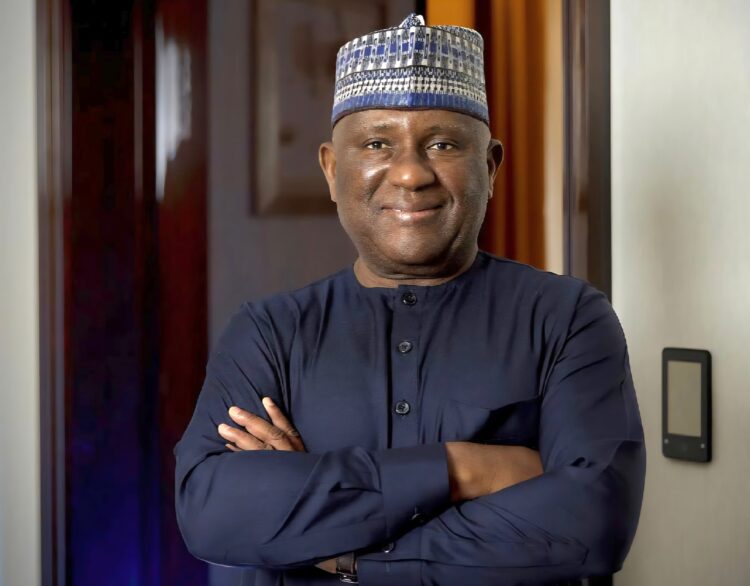
By all the standards by which society keeps score of wealth, influence, and industrial power, the verdict is official: Alhaji Abdulsamad Rabiu has arrived at a new summit of African capitalism.
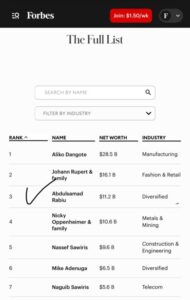
The latest Forbes 2026 Africa’s Richest People list has delivered the news with the kind of clarity that causes a ripple through boardrooms, policy circles, and the gossip-laden corridors of Nigeria’s high society. Rabiu, the quietly formidable chairman of BUA Group, has surged to become the third richest man in Africa and Nigeria’s second richest billionaire, behind only Aliko Dangote.
And in the subtle but unmistakable theatre of billionaire rankings—where reputations swell and rivalries whisper across private jets and marble lobbies—Rabiu’s rise carries a particularly striking detail: he now stands significantly ahead of Mike Adenuga, the telecoms magnate who occupies the sixth position on the continental list.
The numbers tell their own spectacular story.
Rabiu’s fortune has soared to $11.2 billion, a staggering 120 percent jump in wealth, equivalent to an increase of $6.1 billion in just one year. In the delicate mathematics of global capitalism, such leaps are rare, dramatic, and impossible to ignore.
The catalyst behind this remarkable ascent lies largely in the meteoric performance of BUA Cement, Rabiu’s flagship industrial crown jewel, whose shares climbed by an extraordinary 135 percent over the past year—outpacing even the roaring Nigerian Stock Exchange.
In the flamboyant, occasionally theatrical universe of billionaire wealth rankings, such a leap is not merely a statistic; it is a declaration.
It says: something profound is happening inside the Rabiu empire.
It also says something about Nigeria.
For decades, conversations about the commanding heights of Nigerian capitalism have tended to orbit around a small constellation of names. The gravitational centre has always been Aliko Dangote, whose colossal industrial footprint—spanning cement, sugar, fertiliser, and now oil refining—remains unrivalled.
Behind Dangote, another titan historically commanded the narrative: Mike Adenuga, the famously reclusive founder of Globacom and Conoil.
Yet the new Forbes list rearranges this familiar hierarchy.
Rabiu now sits firmly between Dangote and the rest of Africa’s billionaire class, occupying third place on the entire continent, behind South Africa’s luxury goods magnate Johann Rupert but ahead of a formidable gallery of industrialists and financiers from across Africa.
It is a position that would have seemed improbable to some observers only a few years ago.
But those who have watched Rabiu closely know that the Kano-born businessman has always been playing a long game—one defined less by flamboyance than by disciplined industrial expansion.
Indeed, if there is anything striking about Rabiu’s public persona, it is his almost studied indifference to the spectacle of wealth rankings.
Those who know him insist that he neither courts the headlines nor measures success in the language of billionaire lists. His preferred wordbook is discernible in his factories, production capacity, towering infrastructure, and peerless philanthropy.
Consider the broader context. Africa’s billionaire class has never been richer. According to Forbes, the continent’s wealthiest tycoons now command a combined fortune of $126.7 billion, a remarkable 21 percent increase from the previous year.
Equity markets across the continent have rallied sharply, currencies have stabilised in key economies, and major corporations have delivered record profits.
In the midst of this rising tide, Rabiu has emerged as the biggest gainer of them all. That distinction matters, because while billionaire rankings may sometimes feel like the glossy scoreboard of global capitalism, they also reveal deeper truths about industrial momentum, corporate strategy, and economic transformation.
Rabiu’s rise is not the product of speculative finance or tech-driven volatility. It is rooted in something far more tangible: cement, steel, sugar, flour, and infrastructure, the hard architecture of economic development.
Through BUA Group, Rabiu has built an industrial ecosystem that touches some of the most fundamental sectors of Nigeria’s economy. From cement plants powering construction booms to sugar refineries supplying domestic markets, his companies operate at the intersection where private enterprise meets national development.
It is precisely this industrial character that makes Rabiu’s rise particularly fascinating to watch.
For while the global billionaire class often conjures images of Silicon Valley disruptors or cryptocurrency wunderkinds, Rabiu’s fortune grows in the more traditional language of factories, ports, and supply chains.
In other words, his wealth expands in ways that are intimately tied to the physical growth of the economy. And perhaps that is why his ascent has begun to attract a certain admiration—even among those who are otherwise sceptical of billionaire narratives.
Because behind the dazzling $11.2 billion valuation lies a story about scale, discipline, and strategic patience.
Rabiu is, in many ways, the antithesis of the flamboyant mogul. He rarely indulges in grand public theatrics. He avoids the extravagant social visibility that sometimes accompanies great fortunes. Instead, he cultivates the air of a man perpetually immersed in the mechanics of industry.
Friends describe him as intensely focused, relentlessly analytical, and almost monk-like in his dedication to business strategy. Perhaps this is why the Forbes ranking feels less like a personal triumph for Rabiu and more like an institutional milestone for the BUA empire.
For years, BUA Cement has quietly expanded production capacity across Nigeria, positioning itself as one of the country’s most formidable industrial forces. The recent surge in its share price suggests that investors have finally begun to appreciate the scale of that ambition.
Markets, after all, reward momentum. And momentum is precisely what the Rabiu enterprise seems to possess in abundance. Yet there is also a symbolic dimension to this new ranking.
In the subtle social theatre of Nigerian elite circles, wealth rankings are never merely about money. They shape perception.
They influence how global investors, policymakers, and even rival entrepreneurs interpret the balance of economic power. Rabiu’s elevation to Africa’s third richest man sends a clear signal that the BUA Group is no longer simply an ambitious challenger within Nigeria’s industrial hierarchy. It has become one of the continent’s defining corporate forces.
And yes, there is the matter of Mike Adenuga. For decades, Adenuga’s legend has occupied a near-mythical space in Nigerian business folklore—the brilliant telecoms tycoon who built Globacom into a pan-African powerhouse while maintaining an almost hermetic personal privacy.
His fortune, now estimated at $6.5 billion, still places him comfortably among Africa’s billionaire elite. But Rabiu’s dramatic surge has now positioned him far ahead of Adenuga in the continental rankings, underscoring just how rapidly the BUA chairman’s financial profile has expanded.
Such shifts inevitably spark conversations in Nigeria’s elite circles. At private dinners in Ikoyi and boardrooms in Victoria Island, the talk has already begun. What exactly is driving Rabiu’s extraordinary rise? How far can the BUA empire expand?
The symbolism of Rabiu’s ascent is unmistakable. It represents the emergence of a new industrial pole within African capitalism. More importantly, it highlights the remarkable potential of Nigerian enterprise when it is driven by long-term vision rather than short-term opportunism.
There is also another dimension to Rabiu’s reputation that deserves mention: philanthropy. Through the Abdul Samad Rabiu Africa Initiative, the billionaire has committed billions of naira to health, education, and social development across Nigeria and the wider continent.
In recent years, his foundation has financed major interventions in university infrastructure, healthcare facilities, and pandemic relief.
This philanthropic posture adds another layer to the narrative of his rise.
Rabiu appears increasingly interested in shaping not only industrial capacity but also social impact. And perhaps that is why his latest ranking resonates beyond the glitter of billionaire gossip.
Because in a continent often starved of positive economic narratives, Rabiu’s ascent offers something quietly inspiring: proof that African entrepreneurs can build vast industrial empires without abandoning the continent’s development priorities.
Still, if you were to ask Rabiu himself about the Forbes ranking, those close to him say he would likely shrug it off with polite indifference.
He is not known to obsess over such lists. In his world, success is measured less by billionaire rankings than by production capacity, factory output, and the steady expansion of industrial infrastructure.
But society, of course, loves its scoreboards. And this year’s scoreboard delivers a clear verdict. Abdulsamad Rabiu is now Nigeria’s second richest man and the third richest billionaire in Africa.
It is a moment worth noting, not merely for the spectacle of wealth but for what it says about ambition, strategy, and the evolving landscape of African enterprise.
As the conversation about the future of African capitalism evolves, Rabiu’s name now sits closer to the very top of the table. And whether he seeks the spotlight or not, the numbers have already placed it firmly upon him.