
● From Third To Second In Four Weeks: Rabiu Overtakes Rupert, Leaves Mike Adenuga, Kirsh Far Behind To Claim Africa’s No. 2 Spot
● The Billionaire Blitz: Magnate’s Billion-Dollar Surge Rewrites Continent’s Rich list, Says Forbes
● Why Markets Crowned Him Africa’s Fastest-rising Billionaire
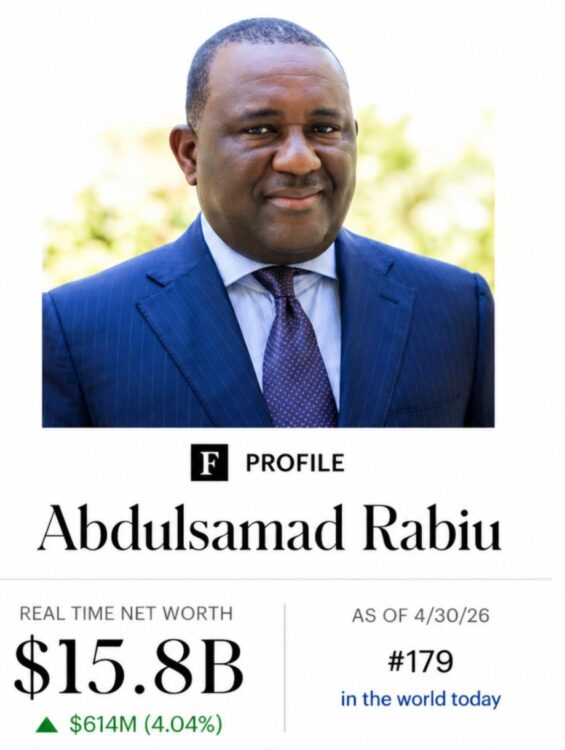
Yes, the distance has closed. The hierarchy has shifted as Alhaji Abdulsamad Rabiu stands second.
A remarkable transformation unfolds within a span that barely registers on the calendar. Markets have a way of compressing time, turning months into moments and moments into milestones.
A curious theatre surrounds the ritual of billionaire rankings. Numbers glide across glossy pages with ceremonial cadence. Fortunes swell and contract like fiery tides under a distant moon. Through it all, names ascend, names recede, and somewhere between arithmetic and mythology, power rearranges itself.
Every so often, a shift occurs with such quiet force that it demands attention. This is one of those moments.
Barely one month after Forbes declared Abdulsamad Rabiu Africa’s third richest billionaire, with a net worth of $15.9 billion, the axis has tilted again. The Kano-born industrialist now stands as the continent’s second richest man, his fortune towering at $15.8 billion. A slight numerical dip, yet a leap in rank, a paradox that captures the restless trajectory of global wealth.
The scoreboard has moved, according to Forbes. But the story runs deeper than numbers.
Speed defines Rabiu’s ascent, considering how far and gloriously his wealth has grown. A year that began with measured expectations has unfolded into a season of acceleration, lifting his net worth by billions and placing him among the most formidable figures in African capitalism.
The billionaire index tells part of the tale. A year-to-date gain of $5.78 billion positions Rabiu as the best-performing billionaire on the continent. That distinction alone carries weight. It signals momentum, the kind that reshapes investor sentiment and redraws maps of influence.
South Africa’s Nathie Kirsh had, until recently, worn that mantle with a gain of $5.29 billion. Markets, however, remain indifferent to yesterday’s triumphs. Rabiu’s surge has overtaken Kirsh’s performance, reclaiming lost ground and pushing forward with a quiet, relentless energy.
A climb from fifth to third. A surge to second. Each movement reads like a drumbeat in an unfolding symphony of industrial ambition.
The hierarchy, no doubt, has been rewritten. Africa’s billionaire power structure has long appeared carved in granite. At the summit stands Aliko Dangote, his fortune towering at $33.6 billion, a scale that feels almost geological. Beneath him, a rotating constellation of industrialists, financiers, and magnates has jostled for position, each ascent measured against the continent’s evolving economic currents.
Rabiu’s rise disrupts that familiar order. Three weeks ago, the gap between second and third carried a certain permanence. Johann Rupert, custodian of luxury empires and refined capital, held the second position with $18.0 billion. A decline of $1.42 billion since the start of the year softened his standing, creating a narrow corridor through which Rabiu advanced.
Understanding Rabiu’s ascent requires a journey beneath the surface of the numbers. Wealth, at this altitude, rarely moves without structural cause. Behind his fortune lies a lattice of industrial decisions, market timing, and strategic expansion that has matured into full expression.
At the heart of this transformation stands BUA Group, a conglomerate whose reach spans the foundational sectors of modern economies. Cement, sugar, flour, infrastructure: these industries form the skeletal frame upon which nations rise.
BUA Cement, the crown jewel, has delivered extraordinary performance. Share prices have climbed with a force that commands attention, riding a broader wave of optimism within Nigeria’s equity markets.
Pension reforms, increased institutional participation, and stronger corporate earnings have injected liquidity into the system, lifting valuations across sectors.
Yet even within this buoyant environment, BUA Cement has distinguished itself. Investors have begun to perceive something deeper than cyclical growth. They see scale, coherence, and an industrial architecture expanding with purpose.
Rabiu’s wealth reflects that perception. There is no gainsaying that January offered a different picture. Rabiu’s net worth stood at $10.4 billion, placing him fifth among Africa’s richest individuals. The position felt respectable, even stable. The climb ahead seemed gradual.
February shifted the tempo. A rise to $11.3 billion, accompanied by a year-to-date gain of $1.21 billion, signaled acceleration. The gap between contenders began to narrow.
March arrived with a dramatic leap. Net worth surged to $14.6 billion, propelling Rabiu into fourth place on the continent. The global ranking followed suit, elevating him to the 197th richest person in the world.
Weeks later, the ascent accelerated as a fortune of $15.9 billion restored him to third place, overtaking rivals and reasserting his position among Africa’s elite.
Now, with a $15.8 billion networth, the leap to second place completes a trajectory that reads like a case study in velocity.
Few fortunes move with such intensity within a single year.
No doubt, an intriguing paradox defines Rabiu’s public persona. The scale of his wealth commands attention; yet, his temperament resists it.
Associates describe a man inured to the demands of industry rather than spectacle. In his circle, conversations gravitate toward production capacity, logistics, and market evolution; thus, the theatre of billionaire rankings holds little allure to the billionaire magnate.
Yet, the spotlight persists, thus asserting that wealth, especially at such a magnitude, bears its own gravity. It pulls attention inward, regardless of personal inclination. Headlines emerge, comparisons unfold, and narratives take shape.
Rabiu’s ascent unfolds within this tension like a quiet temperament navigating a loud landscape. A defining characteristic distinguishes his fortune from many contemporary narratives of wealth creation. His empire rests on the tangible foundations of the real economy.
Cement forms cities. Sugar feeds populations. Flour sustains daily life. Infrastructure binds markets together. These sectors lack the glamour associated with digital innovation, yet they anchor economic reality.
Rabiu’s wealth grows from these foundations. Each factory, refinery, and logistics network contributes to a system that generates value at scale. The result appears in balance sheets and market valuations, translating physical output into financial power.
This connection to the real economy lends his ascent a certain solidity. It feels constructed rather than conjured, built layer by layer over time.
Rabiu’s rise signals more than personal achievement. It points toward a broader shift within African capitalism. For decades, narratives of wealth on the continent have revolved around a handful of dominant figures. Dangote’s industrial empire, Adenuga’s telecommunications and oil ventures, Rupert’s luxury conglomerates, these names defined the contours of power.
Rabiu certainly introduces a new axis. His ascent expands the field, adding another pole of influence within the continental economy. Supply chains, manufacturing capacity, and infrastructure networks increasingly bear the imprint of his strategic decisions.
Africa’s economic landscape evolves through such shifts.
Yet, one of the most striking consequences of Rabiu’s ascent lies in its impact on Nigeria’s internal hierarchy of wealth. For years, Mike Adenuga occupied a secure position among the nation’s richest figures, his telecom and oil empire anchoring his fortune.
The new order tells a different story.
Rabiu’s $15.8 billion places him comfortably ahead of Adenuga’s $6.5 billion, widening a gap that has grown with remarkable speed. The shift reverberates through boardrooms and business circles, prompting recalibration of influence and prestige.
Wealth rankings function as a social barometer. They map not only financial standing but also perceived authority within the corridors of power.
Rabiu’s rise redraws that map. This reality resonates against the backdrop of markets speaking a language of their own: through price movements, capital flows, and investor behavior. Rabiu’s ascent reflects a narrative the markets have been telling for months.
Confidence has flowed into sectors aligned with his business interests. Infrastructure spending, construction activity, and industrial output have created fertile ground for growth. Investors have responded, channeling capital toward companies positioned to benefit.
BUA Cement stands at the centre of this narrative. Its performance captures the intersection of macroeconomic trends and corporate strategy, translating broader shifts into tangible gains.
The result appears in Rabiu’s net worth, a reflection of market belief.
Wealth at this level, however, carries responsibilities that extend beyond commerce. It is on this note that Rabiu’s philanthropic initiatives adds another dimension to his influence.
Through the Abdul Samad Rabiu Africa Initiative, substantial investments have flowed into education, healthcare, and social development. Universities have received funding for infrastructure projects. Hospitals have benefited from targeted interventions. Communities have experienced tangible improvements.
These efforts shape public perception, positioning Rabiu as a figure whose impact transcends balance sheets. The combination of industrial strength and philanthropic reach creates a multifaceted presence within society.
Influence expands accordingly. A net worth of $15.8 billion represents more than a financial figure. It encapsulates decades of strategic decisions, risk-taking, and persistence. Each dollar reflects an underlying asset, a productive enterprise, or a market valuation shaped by collective belief.
Yet numbers alone fail to capture the full story. They hint at scale, suggest momentum, and provide a framework for comparison. Beneath them lies a narrative of construction, an empire assembled through deliberate effort. Rabiu’s ascent embodies that narrative.
Africa’s business community observes these shifts with keen interest. Rankings influence perception, perception shapes investment, and investment drives growth. The ripple effects extend beyond individual fortunes, touching economies and industries.
Rabiu’s rise offers a case study in possibility. It demonstrates how industrial focus, strategic expansion, and favorable market conditions can converge to produce rapid transformation.
For aspiring entrepreneurs, the message resonates. Scale remains achievable and growth remains attainable on a path built on vision and execution.
Three weeks. That span captures the essence of Rabiu’s transformation. A brief interval separates Rabiu’s third-place standing from his current position as Africa’s second richest man.
Such compression of time reflects the pace of modern markets. Information travels instantly, capital moves swiftly, and valuations adjust with remarkable speed.
Rabiu’s ascent embodies this dynamic. Yet, amid the headlines and rankings, the daily work continues. Factories operate, shipments move, and projects advance. The machinery of industry turns without pause.
This continuity anchors Rabiu’s empire. Wealth fluctuations may capture attention, yet the underlying operations sustain long-term value. Production remains constant.
In the end, Rabiu’s journey resists simple conclusion. The current ranking marks a milestone within an ongoing narrative. Future chapters will depend on market conditions, strategic decisions, and broader economic trends.
Billionaire rankings possess a peculiar allure. They reduce complex economic realities to a sequence of numbers, creating a narrative that feels both accessible and dramatic. Rabiu’s ascent exemplifies this allure.
From fifth to second within months. From $10.4 billion to $15.8 billion. From relative obscurity within the upper ranks to a commanding position near the summit. The scoreboard tells the story in plain terms.