

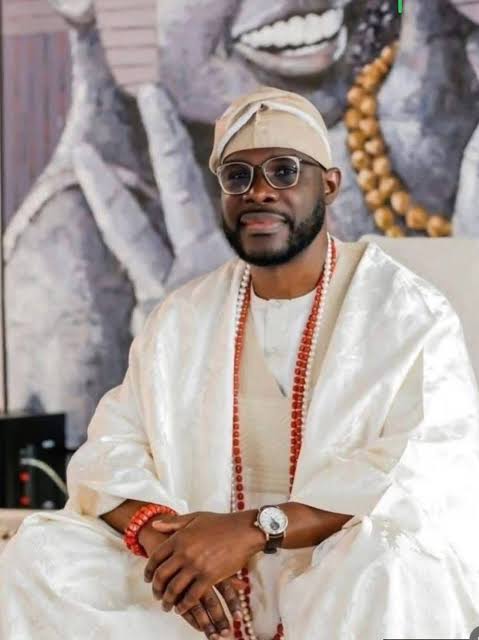
● Kingmakers circle candidate for whom influence, wealth, and public goodwill converge
● A groundswell of support positions Sanwo-Olu’s buddy as new favourite for the throne
● Why Ijebus are betting on a new order
A kingdom listens differently when destiny begins to speak in unfamiliar accents. Across Ijebuland, whispers carry weight, and the air hums with expectation shaped by reality and motion. The ancient stool of the Awujale, long guided by lineage, age, and ritual patience, now draws toward a figure whose ascent reflects the pulse of a new era: Abimbola Onabanjo.
Crowns often travel with consequence, borne by the murmurs of those who sense a shift before it fully announces itself. Ijebuland, steeped in the wisdom of ancestry and the authority of custom, now finds itself poised at such a threshold. The passing of Oba Sikiru Adetona left behind a vacuum filled with memory, discipline, and a towering legacy of custodianship. Yet even as the past lingers, the future presses forward with insistence.
Within that charged space, Abimbola Onabanjo emerges with unusual clarity. His name travels swiftly through town squares, private councils, and diaspora conversations. Support gathers around him with a steadiness that suggests alignment rather than accident. Among Ijebu natives, particularly those who prize order, industry, and civic discipline, his candidacy resonates with striking force.
Conversations about him rarely descend into idle admiration. They tend toward evaluation, toward the careful weighing of character, contribution, and capacity. Those who speak in his favour point first to his generosity, not as spectacle but as habit. Quiet interventions, strategic support and a pattern of giving that reflects both empathy and calculation. In communities where memory is long and gratitude enduring, such gestures rarely dissipate.
Yet philanthropy alone does not animate this groundswell. Influence, measured, cultivated, and deployed with precision, forms another pillar beneath his rising profile. His proximity to power, particularly his relationship with Babajide Sanwo-Olu, has drawn considerable attention. Within Lagos’ intricate ecosystem of governance and enterprise, proximity translates into opportunity. Opportunity, when harnessed effectively, becomes leverage.
Observers describe a dynamic that is both strategic and symbiotic. Sanwo-Olu’s administration provided a fertile terrain for Onabanjo’s expansion, while Onabanjo’s reliability reinforced his standing within that orbit. Wealth accumulated, networks deepened, visibility earned recognition, and recognition matured into influence that now stretches beyond the corridors of Lagos into the ancestral consciousness of Ijebuland. What once appeared as proximity or seemed incidental now reveals a pattern of deliberate ascent.
Within elite circles, Onabanjo carries a reputation shaped by restraint. Both his appearances and words are measured. Such composure, often mistaken for distance, has amplified his mystique. It invites curiosity while commanding respect. Those who encounter him leave with impressions that linger; of quiet authority and a mind attuned to both detail and direction.
His household mirrors that equilibrium. Alongside him stands Tolu Onabanjo, whose professional achievements reinforce a partnership grounded in competence and shared ambition. Their union projects stability, an image of modern aristocracy constructed through enterprise, discipline, and vision. Within a society that reads symbols with acute sensitivity, such imagery matters.
Yet the unfolding story do not rest solely on optics. Beneath the polished exterior lies a record of enterprise that has steadily expanded across sectors. From structured ventures in energy to strategic incursions into services and hospitality, his footprint reflects a consistent philosophy: identify gaps, design systems, execute relentlessly. Associates speak of a leader who follows through, who resists the temptation of half-measures, who understands that credibility compounds through delivery.
That ethos has travelled with him into public service. His tenure within the Lagos State government, particularly in roles demanding coordination and precision, deepened his understanding of governance beyond theory. Colleagues recall an operator who approached assignments with clarity, who insisted on completion rather than mere initiation. It is a reputation that now feeds into perceptions of his readiness for a throne that demands both symbolism and substance.
Ijebuland, after all, does not crown lightly. The Awujale embodies continuity, serving as custodian of memory and interpreter of change. Every occupant of that throne carries the burden of representing a people whose identity has been shaped by centuries of trade, diplomacy, resilience, and cultural sophistication. To be considered worthy is to be measured against both history and expectation.
Onabanjo’s candidacy invites precisely such measurement. His supporters argue that his life reflects the adaptive intelligence required for contemporary leadership. They point to a man who has navigated complexity, who has built structures where none existed, who has maintained relationships across diverse spheres without fracturing under pressure. These qualities, they contend, align with the demands of a modern monarch, one who must engage not only with elders in ancestral halls but also with investors, policymakers, and a global diaspora.
The youth of Ijebuland, in particular, appear drawn to this vision. Within their conversations, his story carries the resonance of possibility. It suggests that influence can emerge from effort, that leadership can be shaped through engagement with the present rather than reliance on the past alone. Such identification does not erase reverence for tradition; it reframes it, situating heritage within a living, evolving context.
Among older generations, reactions are more layered. Respect for his achievements coexists with caution. Questions arise—not as resistance, but as responsibility. What form will his reign take? How will he balance the sacred rhythms of tradition with the pragmatic demands of a rapidly changing society? Can a man shaped by commerce fully inhabit the spiritual and cultural dimensions of kingship?
These questions drift through palaces and parlours, carried by voices that understand the stakes. For Ijebuland, the choice of an Awujale is never merely administrative. It determines how the past converses with the future, how identity is preserved even as circumstances evolve.
Kingmakers, those custodians of process and arbiters of legitimacy, find themselves at the centre of this moment. Reports of their growing preference for Onabanjo have unsettled long-held assumptions. Conventional expectations, which once favoured candidates defined by age and entrenched lineage positioning, now appear less certain. The calculus has shifted. Merit, influence, and perceived capacity have entered the equation with unprecedented weight.
Such a shift does not occur without tension. Tradition, by its nature, resists abrupt transformation. Yet history reveals that endurance often depends on adaptation. Institutions that refuse to engage with change risk obsolescence. Those that negotiate it thoughtfully retain relevance while preserving essence.
Onabanjo’s emergence, therefore, becomes emblematic of a broader understanding, that leadership in the present age requires fluency across multiple domains. Cultural literacy must coexist with economic insight. Spiritual stewardship must align with administrative competence, and authority must be both inherited and earned.
His lineage provides a bridge into that inheritance. Through ancestral connections that trace back to revered royal lines, he stands anchored within the historical framework of the throne he seeks. Heritage, in this sense, does not oppose his modern trajectory; it complements it, grounding ambition within continuity.
Beyond lineage, his relationship with national power adds another dimension. A widely circulated moment featuring him alongside Bola Ahmed Tinubu has intensified perceptions of his reach. The image captures more than proximity; it symbolizes alignment between emerging and established influence. For many observers, it signals a candidate positioned not only within local dynamics but within national conversations.
Such positioning carries implications. An Awujale with access to federal corridors could translate cultural authority into tangible benefits for Ijebuland—investment, infrastructure, strategic partnerships. It presents a vision of kingship that extends beyond ceremonial functions into active engagement with development.
Supporters frame this as an advantage that cannot be ignored. They argue that the demands placed upon traditional institutions have evolved. Communities now look to their monarchs as intermediaries, advocates, and facilitators. A ruler equipped with networks and resources becomes a conduit through which aspirations can find expression.
Critics, where they exist, caution against conflating access with suitability. They urge a careful distinction between influence and wisdom, between wealth and stewardship. Their voices, though measured, contribute to the richness of the discourse, ensuring that the process remains reflective rather than impulsive.
Amid these currents, one element remains consistent: Onabanjo’s appeal among a broad spectrum of Ijebu natives who value order, discipline, and communal advancement. Their support is neither accidental nor superficial. It stems from observation, from engagement, from a sense that his trajectory aligns with their aspirations for a kingdom navigating the complexities of the present.
Stories circulate of interventions that changed lives, of support extended without fanfare, of a generosity that operates quietly yet effectively. Such narratives, repeated across communities, form a tapestry of goodwill that strengthens his candidacy. They suggest a man attuned to the needs of his people, capable of translating personal success into communal benefit.
As momentum gathers, the symbolic weight of his potential emergence becomes increasingly apparent. A 45-year-old ascending to one of the most revered thrones in Yorubaland would represent a striking departure from established patterns. It would signal a willingness to entrust the future to a generation shaped by different experiences, different challenges, different opportunities.
That symbolism extends beyond age. It touches on the evolving definition of authority itself. Power, once confined to specific pathways, now travels through diverse channels. Economic strength, strategic relationships, and global exposure contribute to a composite form of leadership that traditional structures are beginning to acknowledge.
Onabanjo embodies that composite. He stands as a figure forged at the intersection of enterprise and governance, of local identity and broader influence. His candidacy, therefore, becomes a lens through which Ijebuland examines its own evolution.
Moments of such examination are rarely comfortable. They demand introspection, courage, and a willingness to confront uncertainty. Yet they also offer opportunity—the chance to redefine without erasing, to innovate without abandoning.
For Ijebuland, this moment carries precisely that dual promise. The choice before it is not merely about selecting a successor; it is about articulating a vision. What kind of leadership will guide the kingdom through the coming decades? What balance between tradition and transformation will best serve its people?
Within that inquiry, Onabanjo’s name continues to resonate. It rises in conversations, echoes in deliberations, gathers strength in both public and private spheres. Each endorsement adds weight. Each gesture of support reinforces the sense of momentum.
Still, the final outcome rests within the sacred processes that have governed succession for generations. Ritual, consultation, and consensus will shape the conclusion of this unfolding narrative. Until that moment arrives, anticipation will continue to build, carried by a people attuned to the significance of what lies ahead.
Should the crown settle upon his head, it will do so with the full awareness of history watching. Expectations will rise accordingly. Every decision, gesture, and silence will be interpreted through the lens of a kingdom that values both continuity and progress.
Such responsibility demands more than ambition. It requires discipline, humility, and an acute understanding of the role’s spiritual dimension. The Awujale serves as more than a ruler; he becomes a symbol, a living embodiment of identity, resilience, and collective memory.
Onabanjo’s journey suggests a familiarity with complexity that may serve him well in that role. His life reflects negotiation between worlds, between the demands of enterprise and the expectations of community, between visibility and discretion. These experiences, accumulated over years of deliberate effort, form a reservoir from which leadership may draw.
Yet the true measure will emerge only with time. Crowns reveal as much as they conceal. They test character, amplify strengths, expose weaknesses. They demand a constancy that few environments replicate.
For now, Ijebuland watches. It listens to the cadence of change, to the conversations unfolding within its towns and across its diaspora. It weighs possibilities against principles, aspirations against traditions.
At the centre of this unfolding stands Abimbola Onabanjo, a figure whose rise encapsulates the fluidity of contemporary power, whose support base reflects both admiration and expectation, whose candidacy invites a reimagining of what kingship might become.