

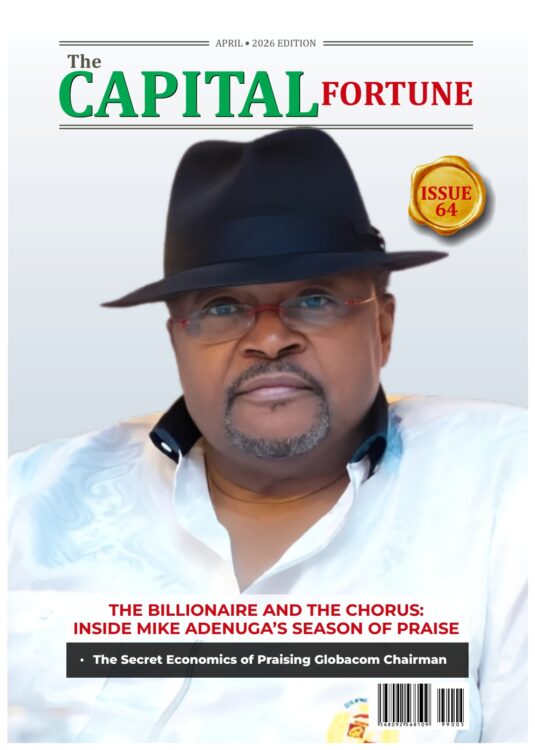
● The Secret Economics of Praising Globacom Chairman
● Every April, like clockwork, the great paradox of Mike Adenuga unfolds.
It resounds in columns and commentaries, glossy tributes and hurried think pieces, each one straining, almost feverishly, to outdo the other.
It is that time of year again when Nigeria’s most elusive billionaire is “exposed,”not by his enemies, but by admirers; by those who hope, perhaps too eagerly, to be seen by him. And what a spectacle it is.
I have watched this ritual long enough to understand the process. The early starters: journalists with a nose for proximity to power, aides with cultivated loyalty, and beneficiaries of past benevolence rush to publish first. Their words are spruced up and their metaphors lush to the point of exhaustion. They speak of thunder and titans, of destiny and divinity, of a man who is less human than myth. Then come the late entrants, those who, fearing irrelevance, tilt their pens into spears of superlative, each sentence a plea disguised as praise: See me. Remember me. Reward me. It is, frankly, a rat race.
And yet, beneath the almost theatrical excess, there lies something more interesting, something that says less about the writers and everything about the man they are trying so desperately to impress.
Because here is the irony that nobody quite admits: Mike Adenuga does not need any of this. In fact, if one understands him even slightly, one suspects he might quietly disdain it. He is not a man built for applause.
There are men who cultivate visibility like a crop, tending to their public image with the meticulousness of gardeners. Then there is Adenuga, who has spent a lifetime doing the opposite, building an empire in deliberate obscurity, speaking rarely, appearing sparingly, and allowing his work to travel where his voice does not. While his fellow magnates get intoxicated by spectacle, he has remained stubbornly, almost rebelliously, private. Which is why this annual flood of tributes feels, to me, like a kind of exposure, an unveiling not of his secrets, but of his contradictions.
For how do you write about a man who refuses to be written into easy narratives? The tributes try, of course. They always do. They reach for the familiar arc: the boy at Ibadan Grammar School, the young man defying parental expectations to study abroad, the entrepreneur who returned to Nigeria not to bask in foreign polish but to build something stubbornly local.
They recount the milestones: Devcom Merchant Bank in his thirties, the audacious leap into oil exploration, the Christmas Day discovery that rewrote Nigeria’s indigenous oil story. And then, inevitably, they arrive at Globacom.
Ah, Globacom. The green revolution that did not announce itself with polite intent but stormed the gates of Nigeria’s telecoms industry with something bordering on insurgency. Those who remember the early days will recall the disbelief: SIM cards sold at prices that felt almost absurd, per-second billing that dismantled the old order, queues that stretched like pilgrimages along Awolowo Road and Saka Tinubu.
But even this story, as often told, misses the deeper point. Because Adenuga’s genius was never merely in the act of entering industries, it was in how he entered them. He does not tiptoe into markets; he rearranges them. Adenuga does not compete in uncertain steps; he redefines the terms of competition. And yet, for all this, he remains curiously uninterested in narrating his own legend. Which brings us back to the annual chorus of praise.
There is something almost comical in the way grown men—seasoned journalists, accomplished professionals—suddenly become lyrical acrobats every April. They stretch language to its limits, bending syntax and sense in their quest to produce the most dazzling tribute. It is as though the act of writing itself becomes a performance, a coded message sent into the void in the hope that it might reach a man who has made an art form of not responding.
Because, honestly speaking, many of these tributes are not written for history. They are written for attention.
And there is no shame in that, at least not entirely. We live in a world where access often determines opportunity, and proximity to power redraws the boundaries of one’s life; it is, therefore, understandable that people would seek visibility in whatever way they can. To praise a man like Adenuga is, for some, not just an act of admiration but a strategic gesture, a way of aligning oneself, however faintly, with his orbit.
But it is also, if we are being candid, a misunderstanding of the man. For if there is one consistent thread in the Adenuga story, it is his indifference to noise. He does not grant interviews on demand. He does not parade his philanthropy with the eagerness of a man seeking applause. His generosity, by most credible accounts, operates in a different tenor: it is quiet, targeted, and often invisible to the public eye. There are beneficiaries who will never write op-eds, never publish glowing tributes, and never participate in the annual April chorus. Their lives, however, bear the imprint of his intervention in ways that no column ever could.
This is not to romanticise Adenuga. He is, after all, a man of immense power, and power is never without its complexities. There are stories of hard decisions, uncompromising standards, and of a temperament that can be as exacting as it is generous. But even these are part of the same person: a titan that resists simplification.
And perhaps that is what makes this yearly “exposure” so fascinating. Because in trying to reduce him to a series of flattering adjectives, the tributes inadvertently reveal how difficult he is to contain within them. They pile on descriptors: visionary, titan, patriot, philanthropist, until the words begin to blur, and the intended meaning itself becomes diluted by excess. Meanwhile, the man remains unchanged.
Seventy-three, on April 29. It is a number that invites reflection, both on longevity and on consequence. What does it mean to have lived not merely long, but significantly? To have altered industries, influenced economies, and shaped the trajectories of countless lives, often without the fanfare that such impact usually attracts?
In Adenuga’s case, it means inhabiting a peculiar space in Nigeria’s imagination: omnipresent yet unseen, influential yet understated, celebrated yet fundamentally unknowable. And so, the tributes will continue.
They will continue in waves over the coming days, each one polished, each one eager, each one hoping to be the definitive word on a man who has spent a lifetime defying definitive words. Some will be sincere, written from genuine admiration. Others will be strategic, calibrated for effect. A few will be both.
I will read them, as I always do, with a mixture of amusement and curiosity. Not because they tell me anything new about Mike Adenuga, but because they reveal so much about us: our hunger for recognition, our instinct to align with power, and our tendency to mistake verbosity for insight.
And yet, despite my scepticism, I cannot entirely dismiss the impulse behind them. Because beneath the excess, the competitive lyricism and the almost ritualistic urgency to be seen praising him, there is something undeniably valid; something that resists cynicism and demands acknowledgement. There is, quite simply, something worth celebrating.
To understand this is to move beyond the noise and examine the psychology of the man himself—Mike Adenuga—not as a figure inflated by annual tributes, but as a force that has consistently altered the terms of engagement within Nigeria’s economic landscape. His distinction lies in both his success, and in the manner of its pursuit. He is not a man who followed opportunity; he reinterpreted it. Where others hesitated, measuring risk with caution bordering on paralysis, he demonstrated a peculiar instinct for seeing beyond the obvious contours of danger into the deeper geometry of possibility.
His entry into industries has rarely been ornamental or incremental. He does not arrive to participate timidly; rather, he arrives to test the elasticity of the system itself. In telecommunications, oil, and finance, for instance, his interventions have carried the same signature: an impatience with inherited limitations and a willingness to redraw boundaries that others accepted as fixed. To call him merely an entrepreneur is to understate the scale of his disruption; he is, in many respects, a revisionist of markets, a man who interrogates the status quo until it yields.
And yet, even this does not fully explain the fascination. Because wealth, in isolation, is neither rare nor inherently admirable. What complicates the Adenuga story is the apparent philosophy underpinning that wealth: the sense, whether deliberate or instinctive, that accumulation is not an endpoint but an instrument. He has deployed capital to consolidate his position and reshape the ecosystems in which he operates. Sometimes the intervention is blunt: market-shifting decisions that force entire industries to rejuvenate. At other times, it is precise: targeted moves that unlock value in ways that appear almost surgical in their execution.
This duality is instructive. It suggests a mind comfortable with scale but attentive to detail, capable of both sweeping transformation and granular control. It also hints at a deeper understanding of power, not as static possession, but as something dynamic, something exercised through timing, perception, and restraint.
Restraint, in fact, may be the most underappreciated element of his persona. While his billionaire peers increasingly equate visibility with relevance, Adenuga’s insistence on privacy manifests as both a personal preference and a measured act of defiance. He has resisted the gravitational pull of publicity that draws so many of his peers into performative visibility. There are no constant interviews, no curated glimpses into his private world, and no deliberate cultivation of celebrity. Instead, there is silence—strategic, consistent, and, in its own way, powerful.
This choice has consequences. It denies the public the easy intimacy that often fuels adulation, but it also preserves a certain mystique, a distance that paradoxically amplifies his presence. Where too many pander to overexposure, he has made absence a form of authority. And that, perhaps, is no small achievement.
To build at scale is one thing; to do so without surrendering to the seductions of constant visibility is another entirely. It requires a clarity of self that is increasingly rare, a confidence that one’s work can speak loudly enough without the amplification of perpetual narration. It also reflects a disciplined understanding of legacy: that what endures is not the volume of one’s voice, but the durability of one’s impact.
So yes, the tributes may be excessive, even self-serving at times. But they are not entirely misplaced. They are, in their own flawed way, attempts to grapple with a figure who complicates easy interpretation, a man whose life invites both admiration and analysis, whose choices challenge prevailing assumptions about power, visibility, and success.
And perhaps that is why, despite everything, the impulse to celebrate him persists. But if we must celebrate him, and we should, in our own way, perhaps we ought to do so with a little more restraint, a little more honesty. Perhaps we should resist the urge to turn him into myth, and instead acknowledge the more interesting reality: that he is a man who has mastered the art of contradiction. A recluse who commands attention. A billionaire who shuns spectacle. A benefactor whose generosity often refuses documentation.
Perhaps, in other words, we should let him remain partially unknown. Because there is a dignity in that mystery, a kind of quiet authority that no amount of florid prose can improve upon. As April 29 approaches, I imagine him somewhere far removed from the noise, unbothered by the columns, untouched by the competition, and unmoved by the annual scramble to define him. The tributes will circulate, the headlines will trend, and the adjectives will multiply.
And he will remain, as ever, himself. Unexposed in the ways that matter. Which, in the end, is the greatest irony of all.