

There is something deliciously ironic about Lagos high society: it adores ambition, but is most unsettled by restraint. It thrives on rumours of “who is next,” feeds on succession gossip like champagne at a Victoria Island dinner, and measures relevance by proximity to power.
So, when the name Tokunbo Abiru began to float, softly at first, then insistently around the question of who might inherit Lagos’ political throne, it was less a rumour than a quiet consensus forming in real time.
The possibility of a “Governor Tokunbo Abiru,” many said, was inevitable. And then, just as the speculation ripened, something profoundly unfashionable happened: he accepted, once again, the nomination to serve as Senator representing Lagos East in Nigeria’s 10th National Assembly.
But contrary to widespread perception that Abiru desired to vie for the Lagos gubernatorial seat at the 2027 elections, he nursed no such ambition. He neither acquired the gubernatorial form nor declared intent for the position because he still had a lot to achieve serving his constituency, Lagos East, and Nigeria in general, in the upper legislative chamber, on the national stage in Abuja.
Yet, within Lagos’ most discerning circles, Abiru had come to represent a compelling possibility for the future of the state’s leadership. The conversations that formed around him were not built on sentiment alone but on a pattern that many found difficult to ignore: a career defined by discipline, a public record marked by restraint, and a style of governance that privileges continuity over spectacle.
Against that backdrop, the expectation that he might emerge as the All Progressives Congress’ next gubernatorial candidate did not feel far-fetched. On the contrary, it felt logical, almost preordained, especially to those who had watched his trajectory with the kind of attention that Lagos society reserves for figures who combine competence with composure.
Yet politics, particularly in Lagos, is never governed by logic alone. It is shaped by alignments, the delicate workings of power within a system that values both continuity and control, and, of course, the innate desire of the candidate and subject of speculation – in this case, Senator Abiru. When the endorsement of the current deputy governor, Obafemi Hamzat, became news, it altered the trajectory of events in a way that was both decisive and revealing.
The path that many had imagined for him was misleading. Abiru had nursed no interest in the governorship seat, at least not for now. Hence, speculations about him stepping aside are grossly misleading.
It is not that Abiru isn’t fit for the job; it just isn’t time yet. His quiet composure amid patronising rumours and calm decision to re-engage with the dreams of his constituency and the pursuit of the collective good at the 10th National Assembly are at once disarming and instructive. Without hesitation, he accepted his nomination to continue serving as Senator representing Lagos East in the legislative chambers. The decision, on its surface, appeared straightforward, but its implications were far more profound than a routine acceptance of political responsibility.
In doing so, Abiru did something even more radical: he made humility look like strategy. At this point, I’d like you to indulge my stance that, over time, within the Lagos political circuit, Abiru’s name had become a kind of code.
“He is the one,” they would say. “The technocrat Lagos needs,” “The banker who understands the state as a balance sheet.”
There was a certain inevitability to the narrative. After all, this is a man who had steadied financial institutions, revivified fiscal systems, and brought a kind of disciplined elegance to governance that felt almost alien in Nigeria’s political culture.
It helped that he did not chase attention. And in Lagos, nothing attracts fascination like such a man. So yes, the speculation was not baseless. It was built on pattern and precedent. It was inspired by performance. And, crucially, by the yearning of a city that occasionally tires of its own excesses.
But Lagos, as always, had other plans. In accepting his nomination to continue representing Lagos East, Abiru stepped deeper into responsibility and the often thankless work of governance.
And that, in a city obsessed with upward motion, is nothing short of revolutionary. Abiru is undoubtedly a rare breed in a predictable system. In accepting his continued role as Senator, he demonstrated something that many politicians only pretend to possess: a genuine commitment to the collective good.
And Lagos must never underestimate how progressive that is. Of course, “Progressive” is a word often thrown around carelessly in Nigerian politics. It has become a label and slogan. But in Abiru’s case, it is something far more substantive. It is instinct.
Progressivism, at its core, is about prioritising systems over personalities, outcomes over optics, and the long-term over the immediate. It requires patience, discipline, and an almost stubborn refusal to be distracted by spectacle. Abiru embodies this.
His decision to continue in the Senate, despite the swirling expectations of a gubernatorial bid, is not a retreat from progress; rather, it affirms it. It says: the work matters more than the position.
Now, let us return to the essence of his politics, because this is where the story acquires its most intriguing texture. What makes Abiru exceptional is not just the fact that he delivers, but the confidence with which he owns those achievements and places them at the centre of his public identity.
Where many rely on rhetoric to mask underperformance, he has reversed the equation, allowing performance to define his rhetoric and using his record as the most compelling argument for his leadership. Across Lagos East, the evidence of his leadership is tangible, visible, and widely acknowledged. Cooperative societies have been restructured and strengthened under his guidance, transforming from fragile entities into disciplined, sustainable platforms for economic participation. Young people across the constituency have been exposed to opportunities that expand their horizons and equip them with the tools to compete in a demanding world, not through token gestures but through carefully designed programmes that prioritise long-term empowerment. Public interventions initiated under his watch are not fleeting gestures designed for applause; they are enduring initiatives that continue to deliver value long after their launch, reinforcing his reputation as a leader who builds for permanence.
Abiru’s interventions ultimately reveal a philosophy of public service rooted in continuity, credibility, and consequence. The bond, taxes, cooperatives, innovation labs, poultry schemes, food packs, renovated classrooms and clinics all these are often narrated as separate achievements. But taken together, they constitute a single narrative of governance. Each action reinforces the other. And each decision, whether made in a bond market boardroom or a crowded community square, draws from the same premise: that trust is the most valuable currency a public institution can hold, and that it must be earned repeatedly, not proclaimed.
For market women, farmers, artisans, and youth groups, his grants functioned as more than capital. They were affirmations of his care and signals that, as a politician and public servant, he understands the logic of grassroots economies and respects their capacity for self-organisation. The testimonies describing the grants as “financial boosters” are instructive not because they are emotive, but because they are precise. A booster does not replace effort; it amplifies it. In that amplification lies sustainable development.
The same principle undergirds the SAIL Innovation Lab. Abiru’s decision to invest in digital skills is both pragmatic and visionary. Training over a hundred young people who now secure high-paying AI jobs is no small feat. Each employed graduate represents a reduced dependency ratio, an expanded tax base, and a new node of global connectivity. Lagos East, through such initiatives, is set for a prosperous future.
Abiru’s approach to governance reflects a sophisticated understanding of the balance between accessibility and authority. He engages with his constituents actively and visibly, ensuring that his presence is felt not just in policy but in personal connection, yet he does so without descending into the performative populism that often dilutes the seriousness of leadership. His communication is deliberate, his engagements purposeful, and his visibility strategic, creating a model of political interaction that is both relatable and effective. This is leadership that does not hide behind technocracy but brings it to the forefront, presenting competence as something to be seen, understood, and appreciated.
There is an undeniable boldness in the way his record challenges the prevailing norms of Nigerian politics. It disrupts the familiar narratives that excuse underperformance and exposes the possibility of consistent, measurable progress within a system often dismissed as resistant to change.
Abiru’s achievements stand as a counterargument to cynicism, demonstrating that with the right combination of discipline, expertise, and commitment, governance can deliver outcomes that are both meaningful and sustainable. His career does not merely suggest this possibility; it proves it repeatedly.
This is why his story demands to be told with better clarity and conviction, not softened by understatement or framed within the cautious language of modest praise. To speak of Abiru is to engage with a standard, to acknowledge a level of performance that sets him apart as one of the most consequential figures in Lagos politics in recent memory. He is not simply part of the conversation; he is shaping it, redefining expectations, and establishing benchmarks that others are compelled to measure themselves against.
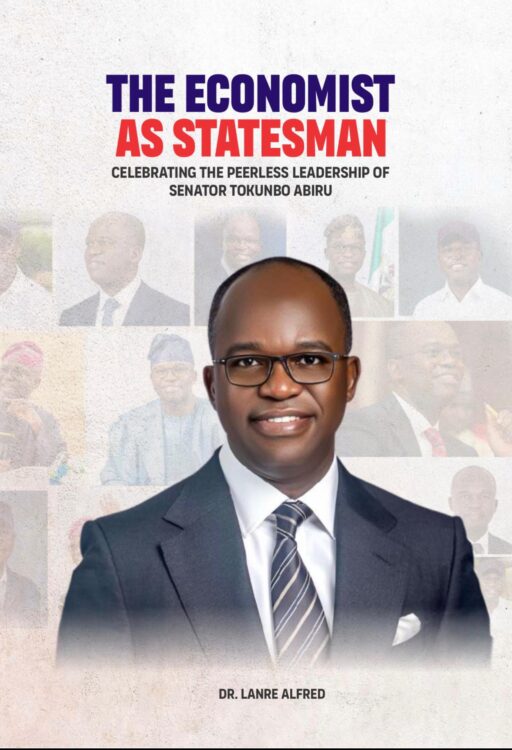
The decision to document his journey in a comprehensive narrative, “The Economist as Statesman,” emerged from a growing frustration with the shallow interpretations that often dominate discussions about his career. The familiar remarks about his technocratic style or his measured demeanour often overlook the more important reality that beneath those traits lies a record of sustained achievement that few can rival.
It became necessary, therefore, to move beyond casual commentary and to engage with his story in a way that reflects its true significance. The result is a narrative that does not pretend neutrality but embraces its purpose as a celebration of a model of leadership that deserves recognition. This is not an exercise in flattery; it is an assertion that excellence, when consistently demonstrated, should be acknowledged with the same intensity that mediocrity is often criticised.
What distinguishes Abiru most clearly is not only what he has achieved but the consistency with which he has achieved it. His career reflects a pattern of intervention at critical moments, a capacity to stabilise institutions and restore confidence where it has been eroded. His tenure in the financial sector, particularly his role in repositioning Polaris Bank, stands as a testament to his ability to navigate complex challenges and deliver results under pressure. His contributions to Lagos State’s financial management further reinforce this reputation, demonstrating a level of competence that has helped sustain the state’s economic stability even in uncertain times.
These accomplishments are not isolated successes; they form a coherent narrative of leadership that is grounded in expertise and executed with precision. They reveal a figure who transforms positions of responsibility and public service, leaving behind systems that are stronger, more resilient, and better equipped to serve their purpose. This is the essence of his impact, and it is what elevates him beyond the ordinary boundaries of political achievement.
Abiru presents a compelling case for the enduring value of a transgenerational literature. His life is deeply connected to the social fabric of Lagos, not in the superficial sense of curated visibility, but in the more meaningful sense of rooted engagement. His ties to Ikorodu, his participation in longstanding communal traditions, and his presence in spaces that prioritise dialogue and continuity all contribute to a sense of authenticity that enhances his public image.
His partnership with his wife, Feyisola, adds another dimension to this narrative, reflecting a balance of ambition and stability that is both admirable and instructive. As an accomplished entrepreneur in her own right, she embodies the same commitment to excellence that defines Abiru’s career, creating a dynamic that reinforces the values of discipline, hard work, and purposeful achievement. Their relationship stands as a model of alignment, demonstrating that personal and professional success can coexist without compromise.
The timing of this narrative is not accidental. It responds to a moment in which the need for clear, credible leadership has become increasingly apparent, and in which the qualities that Abiru represents are more relevant than ever. By placing his story within a broader context, I attempt to highlight both his individual achievements and the implications of those achievements for the future of governance in Lagos and beyond.
The man, Abiru, challenges assumptions and invites a reassessment of what leadership should look like. In celebrating him, one affirms a political culture that rewards competence, values substance, and recognises the revolutionary potential of leadership executed with precision and purpose.
His journey stands as a powerful reminder that Lagos politics, at its best, can produce figures of extraordinary capability, and that in Abiru, the state has found the most compelling and consequential leader of its time.